
Matched to the work
We align skills to your codebase, tooling, and delivery cadence before the engagement starts.

SolveMotive
From motive to operable release
Hire Talent
Add proven developers and specialists who work inside your process. Clear roles, shared rituals, documented handoffs, and talent matched to the stack you already ship with.
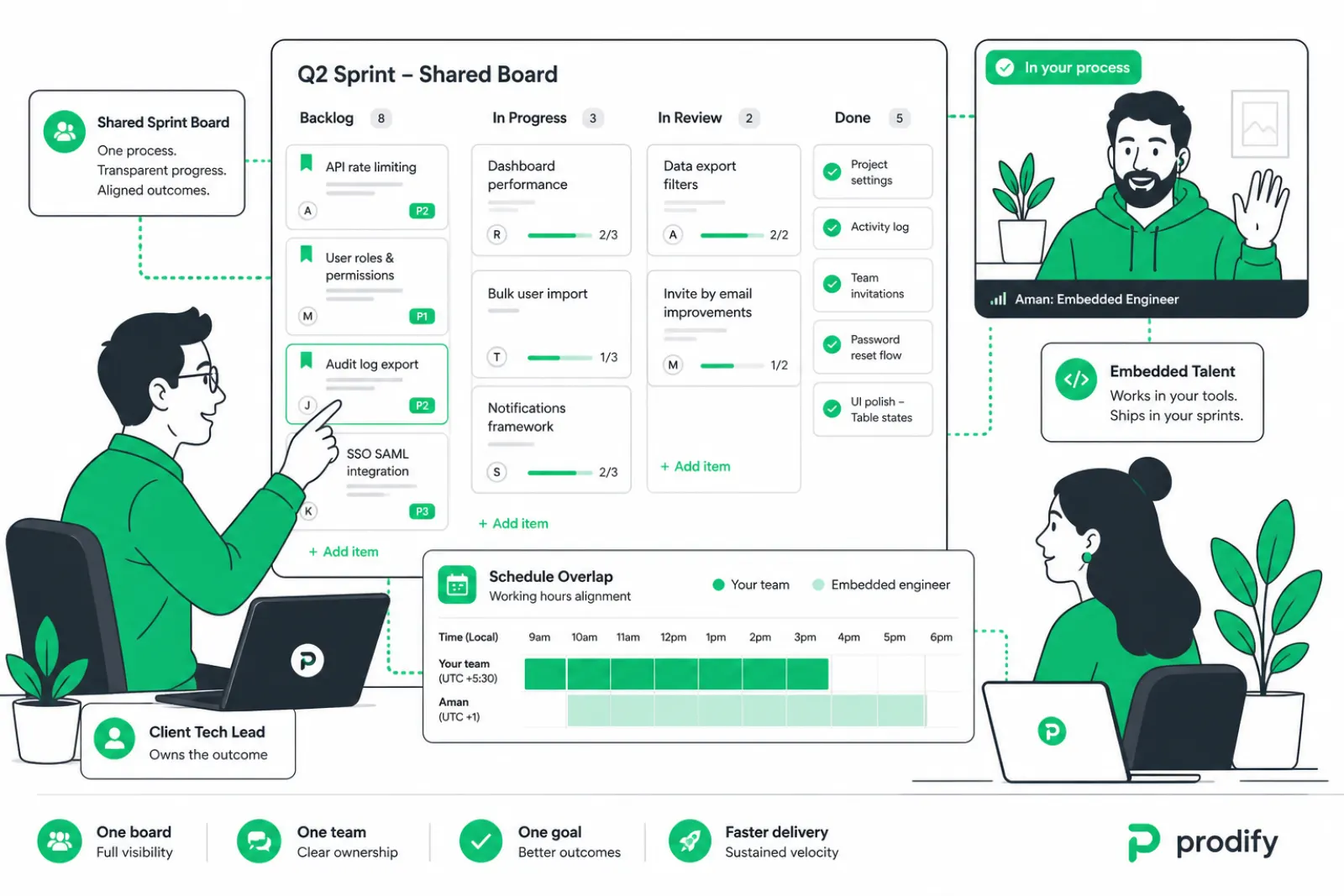
How talent embeds
Kickoffs, shared boards, and review rituals stay visible so ownership transfers cleanly between your team and ours.
Engagement models
Pick the model that matches your operating reality, then review the details and deep links below.
Model A
Add individual engineers for a defined role, stack, and outcome across frontend, backend, mobile, or full-stack.
See detailsModel B
Stand up a focused pod that owns a workstream end to end while staying aligned with your product leadership.
See detailsModel C
Embed talent into your existing squads to cover capacity gaps without changing how your team already ships.
See detailsBuild or hire
When the question is embed vs scoped delivery—or pod depth vs augmentation—start with a clear comparison.
Roles you can hire
Tell us the seat you need filled. We align skills to your codebase, tooling, and definition of done before kickoff.
React, Next.js, Angular, Vue, design systems, accessibility, and performance-minded UI delivery.
APIs, services, data models, integrations, and reliable server-side systems in Node, Python, Java, Go, and more.
Flutter, React Native, and native iOS or Android for store-ready product experiences.
LLM features, retrieval pipelines, evaluation sets, and production monitoring around useful workflows.
Smart contracts, dApps, indexing, and integrations when shared verification is a real requirement.
Research-informed UI/UX that pairs with engineering streams when the work needs stronger experience clarity.
CI/CD, containerization, cloud environments, observability, and release operations that keep delivery stable.
Test strategy, automation, regression coverage, and release confidence for critical product paths.
Know the role you need? Share stack, ownership model, and timeline—we match capacity under your process.
Discuss hiring needsRole-based hiring
Best when you know the role, the stack, and the outcomes you need covered, and you want someone productive quickly without a long recruiting cycle.
We align skills to your codebase, tooling, and delivery cadence before the engagement starts.
Engineers join standups, reviews, and release plans as members of your team, not a remote ticket queue.
Scale the seat up or down as priorities change, with handoff and continuity planned in advance.
Dedicated capacity
Useful when you need a stable group that can plan, build, and ship a product slice while your internal leaders stay focused on direction and priorities.
Combine engineering with design or product support when the stream needs more than implementation capacity.
Planning, demos, and retrospectives stay visible so decisions and trade-offs remain reviewable.
Architecture notes, runbooks, and ownership maps reduce dependency when the engagement winds down.
Staff augmentation
When your process works and you simply need more capacity, we place people inside your squads with the same tools, standards, and definition of done.
We adapt to your branching strategy, review rules, environments, and communication channels.
Scope, reporting lines, and success criteria are explicit so augmentation does not blur ownership.
Documentation and pairing expectations are part of the engagement, not an afterthought at exit.
How engagements start
We keep kickoff short and concrete so you can evaluate fit with real work instead of a long sales cycle.
When this model fits
Technology coverage
Talent is matched to the tools you already use. These are common stacks we place for hire, dedicated team, and staff augmentation engagements.
Why teams hire with us
SolveMotive combines product engineering judgment with flexible staffing so you get useful contributors, not resume volume.
Scope, success criteria, and reporting lines are agreed up front so everyone knows what good looks like.
Standups, code review, sprint planning, and release cadence stay yours. Talent adapts to your operating model.
Documentation, pairing, and exit planning are part of the engagement so knowledge stays with your organization.
Collaborate with teams across the USA, UAE, and worldwide through structured remote delivery and responsive communication.
Start with one developer, expand to a pod, or mix staff augmentation with project delivery when the work changes.
Engineers who ask useful questions, surface risks early, and optimize for maintainable outcomes, not just ticket throughput.
Common questions
Practical answers about roles, stacks, ownership, and how engagements start.
Project engagements are scoped around a defined deliverable we own end to end. Hire Talent embeds people into your process so capacity grows inside your team rituals, backlog, and standards.
Common requests include frontend, backend, full-stack, mobile, AI/ML, blockchain, DevOps, QA, and product design when it pairs cleanly with an engineering stream.
We commonly staff React, Next.js, Node.js, Python, Flutter, React Native, cloud platforms, AI/LLM tooling, and blockchain stacks. Share your repository and tooling details so we can match accurately.
Timing depends on role specificity and access readiness. After we align on requirements, we move to candidate or pod proposals and a practical onboarding plan rather than open-ended recruiting cycles.
Your team leads priorities and acceptance criteria. We ensure contributors stay accountable, communicate clearly, and escalate blockers early without replacing your product ownership.
Yes. Many engagements begin with a single seat, then grow into a dedicated pod or broader staff augmentation once fit and outcomes are clear.
We plan continuity from the start: documentation, paired knowledge transfer, and a structured wind-down so the codebase and operational context remain understandable.
Start with how ownership should work for the next 30 to 90 days. Compare models at /compare, including /compare/staff-augmentation-vs-project-delivery and /compare/dedicated-team-vs-staff-augmentation, then tell us which constraints matter most.
Still stuck on a specific constraint? Book a scoping call →