
Reliable environments
Dev, staging, and production share an explicit model for secrets, networking, and ownership.

SolveMotive
From motive to operable release
Cloud & DevOps
We harden environments and release paths so engineering work reaches users without guessing at runtime ownership.
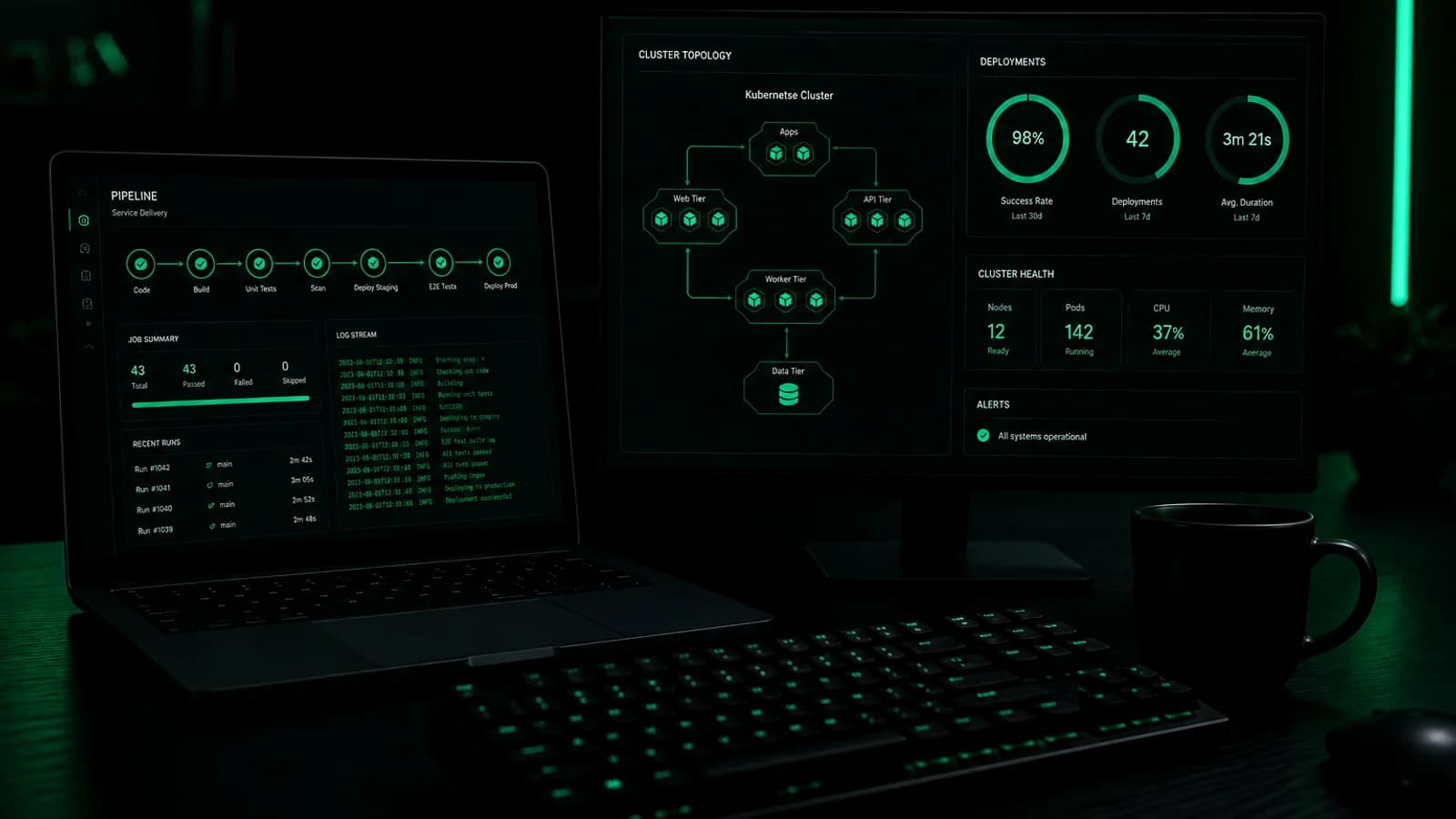
Built for real delivery
Environments, CI/CD, and observability that make product releases predictable.
Focus tags
Capabilities
Scan the map, then open a focused page or stay on this practice for the full engagement model.
Engagement overview
Cloud and DevOps work only pays off when environments, access, release paths, and observability are owned clearly—not when tooling piles up without a promotion model.
We harden the path from commit to production so product teams can ship with recoverable failures and transferable runbooks.
Who we help
Domain outcomes
Dev, staging, and production share an explicit model for secrets, networking, and ownership.
CI/CD and promotion rules match risk tolerance instead of relying on tribal knowledge.
Logs, metrics, alerts, and runbooks give responders a clear first move.
Access, rollback, and infrastructure as code reduce surprise when something breaks.
Capabilities
Final choices follow your operating model and constraints. These are common foundations for cloud & devops work.
Plan the engagement
Resolve these boundaries early so scope and architecture follow the actual product context.
Clarify who owns staging, production, secrets, and promote-to-live authority.
Decide how fast changes should move and what must be proven before promotion.
Define logs, metrics, alerts, and runbooks before traffic depends on the system.
Platform capabilities
Account structure, networking, IAM, environments, and cost-aware architecture.
CI/CD, promotions, rollback paths, and release notes that match your risk model.
Logging, metrics, tracing, alerts, and runbooks for the people on call.
Platform delivery
Cloud and DevOps work starts with environments, access, release paths, and observability before optimizing for speed.
Document environments, secrets, networking, deploy paths, and ownership for each surface.
Build CI/CD, infrastructure as code, and promotion rules that match risk tolerance.
Add logging, metrics, alerts, and runbooks so incidents have a clear first response.
Common questions
Answers to common questions about working with SolveMotive on cloud & devops.
Yes. We start from your current providers, IAM model, environments, and release process, then harden what is risky before introducing new tooling.
Typical scopes cover environment design, CI/CD, infrastructure as code, secrets handling, observability, deployment runbooks, and release ownership transfer.
Yes when containers are a fit. We also keep simpler compute options on the table when orchestration would add more cost than value.
Usually no. We start from what you already run, harden the risky paths, and only introduce new tooling when it clearly reduces delivery or operational risk.
Yes. Platform improvements and product delivery can proceed in parallel when environment ownership and release gates are agreed early.
Still stuck on a specific constraint? Book a scoping call →
Purpose-built software for complex workflows, products, and operational systems.
Test strategy and automation that protect critical paths before every release.
Focused first releases built to test the most important product assumptions.