
1
Care timeline
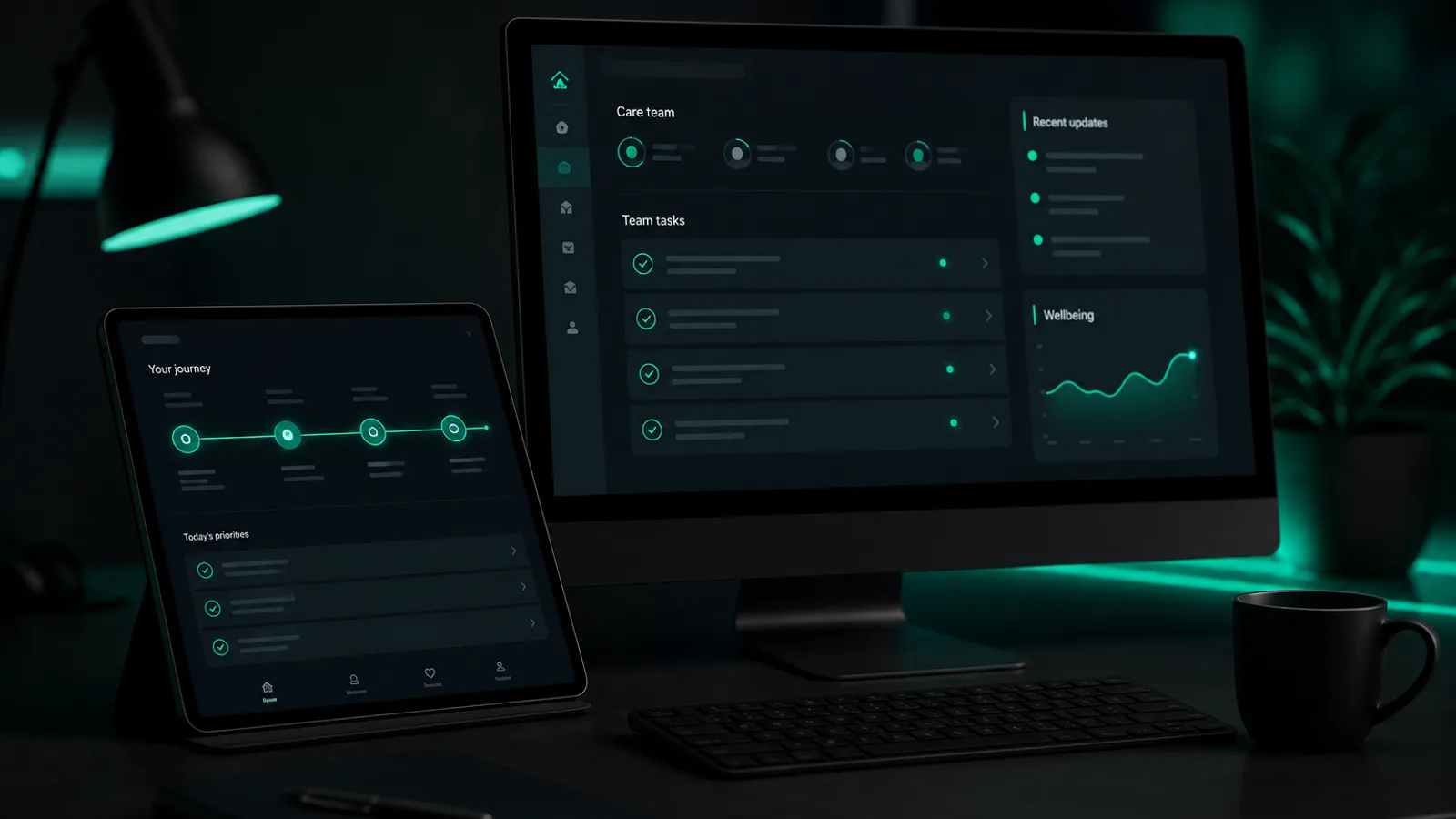
Patients and care teams share one narrative of tasks, messages, and status.

SolveMotive
From motive to operable release
Product concept
This concept shows how scheduling, tasks, messaging, and progress can become one coherent coordination experience without burying clinicians in noise.
Care coordination concept
Healthtech
A representative concept exploring workflows, system boundaries, and product decisions. It does not claim a named client or performance result.
Handoff rail
Concept note
Follow-ups live in inboxes and EHR notes, so patients lack a clear next step and care teams lose ownership across handoffs.
Motive
Follow-ups live in inboxes and EHR notes, so patients lack a clear next step and care teams lose ownership across handoffs.
Coordination succeeds when tasks, consent, and role permissions define who owes the next action—not when chat volume increases.
A handoff-ready coordination surface where patients see actionable steps and teams see owned work.
Model role and consent rules as product requirements so portals never expose care context they should not.
Make tasks the system of record for follow-up so episodes always name who moves next.
Scope messaging and urgency to care context so clinicians are not interrupted by undifferentiated alerts.
Product principles
Healthtech actors
Patients, clinicians, coordinators, and caregivers participate in the same episode with unequal permissions. Coordination holds when consent and task ownership decide who can see and advance work.
InterfaceSees consented next steps and bounded threads in the patient portal—actions tied to the episode, not a free-form inbox.
System shape
Episodes feed tasks under consent and RBAC, then EHR and scheduling sync, with patient and care-team portals at the edge.
Technology map
Why these layers show up in the concept—not a shopping list of logos. Browse the full catalog.
Patient and care-team portals share one web stack while staying usable on phones for after-visit follow-up.
Episode, task, and RBAC logic must live behind explicit services—not only in page components.
Durable task ownership and access decisions need transactional storage with reviewable change history.
Sync contracts should declare ownership at the boundary so portals never pretend to be a full EHR mirror.
Design signals
Illustrative product targets for planning conversations—not measured client results.
1
Care timeline
Patients and care teams share one narrative of tasks, messages, and status.
RBAC
Role boundaries
Who can see or act is a product rule, not an afterthought permission matrix.
2–3
Core workflows
Ship the coordination loops that reduce phone/fax chase first.
Audit
Action trail
Sensitive views and changes leave a reviewable history.
Friction over the handoff
Relative friction before vs after a shared care timeline—planning sketch only.
Phone / fax chase
Before
—
After
—
Unclear next step
Before
—
After
—
Role confusion
Before
—
After
—
Missing audit trail
Before
—
After
—
The operating problem
Scheduling lives in one system, notes in another, and messages in a third. Patients leave an appointment unsure what to do next. Care teams reconstruct context from partial threads and tribal knowledge. When ownership of a follow-up is unclear, work stalls until someone notices the gap.
Generic chat and task tools ignore consent, episode boundaries, and clinical urgency. They flood clinicians with undifferentiated noise while patients still lack actionable instructions. Support contacts and caregivers often need limited visibility, but copying the full patient view creates privacy risk and operational confusion.
Without a shared handoff model, every role invents its own status language. Escalations arrive late. After-hours coverage becomes guesswork. The product problem is not more screens. It is one coherent coordination contract across patient and staff experiences.
The product approach
Start with roles, consent, and episode ownership before interface polish. Every open follow-up should answer who owns it, what is due, and what context is required to complete it. Patient language and clinician language can differ, but status transitions must stay shared.
Bounded messaging attaches threads to episodes and roles so history remains usable and auditable. Notifications distinguish urgency from routine updates so important escalations are not buried. Integrations with scheduling and EHR systems declare authoritative sources, update cadence, and failure behavior up front.
Release in phases that prove handoffs first: patient hub and task board, then messaging and alerts, then deeper sync and caregiver access. Clinical and compliance stakeholders own requirements. Engineering makes those boundaries enforceable in product behavior.
Product judgment
Patients need clear next steps. Care teams need explicit ownership of follow-up. Privacy and role boundaries make generic collaboration tools a poor fit for clinical coordination between visits.
Every open follow-up should answer who owns it, what is due, and what patient context is required.
Ambiguous tasks create silent failure. The coordination model needs assignees, due windows, episode linkage, and completion criteria as first-class fields. Status changes should leave an audit trail so handoffs are reconstructable when staff rotate. Patient-facing copy can simplify language without hiding that someone on the care team still owns the outcome.
Role and consent boundaries determine what can appear. UI composition comes after access rules are settled.
A beautiful portal that leaks the wrong field is a failure. Map which roles can view, message, schedule, or reassign before wireframes lock in. Consent for caregivers and support contacts should be intentional and revocable, not inherited from patient login convenience. Authorization checks belong in the domain layer so mobile and web clients cannot diverge on policy.
Urgency must be distinguishable from routine updates, or important escalations get buried.
If every message pages someone, nothing does. Define severity labels, quiet hours, and escalation paths with clinical stakeholders. Batch routine confirmations. Reserve interruptive alerts for time-sensitive ownership gaps and safety-related follow-ups your policy defines. Let staff mute categories without losing the ability to recover missed work from the task board.
Threads should stay attached to episodes and roles so history remains usable and auditable.
Unbounded chat recreates email inside the product. Tie conversations to a patient episode, visible participants, and related tasks. Preserve who said what and when for continuity and review. Avoid free-form group inboxes that invite side channels. When a message creates work, promote it into an owned task rather than leaving action implied in prose.
Patients act on plain instructions, timing, and clear ways to ask for help between visits.
Clinical shorthand fails outside the clinic. Portal content should state what to do, by when, and what happens if something goes wrong. Separate educational material from required actions so urgency is obvious. Mobile layouts should surface the next appointment and open instructions without forcing patients to hunt through archives.
EHR and scheduling integrations need authoritative sources, cadence, and failure UX before polish.
Fighting over demographics, appointments, or clinical cues creates conflicting truths. Decide which system owns each field and how the portal behaves when sync is delayed, partial, or rejected. Show staleness honestly. Prefer bounded, high-value sync for the first release over attempting to mirror the entire chart.
Build path
A practical sequence for proving ownership, messaging, and sync without boiling the ocean on day one.
Flow at a glance
Step 01
Workshop who can view, act, escalate, and support. Capture caregiver access rules and after-hours coverage expectations with clinical and compliance stakeholders.
ArtifactRole-consent matrix and episode state glossary
Step 02
Define assignees, due windows, escalation triggers, and completion criteria. Align patient-visible status language with internal ownership states.
ArtifactHandoff domain model and status transition map
Step 03
Validate that the same episode produces clear next steps for patients and actionable work queues for staff without duplicating conflicting status.
ArtifactPaired flow prototypes and review findings
Step 04
Attach threads to episodes, enforce participant visibility, and wire notification severity so routine updates do not drown escalations.
ArtifactMessaging policy and alert threshold guide
Step 05
Connect high-value fields first. Document ownership, cadence, reconciliation, and what users see when sync fails or lags.
ArtifactIntegration contract and failure-mode checklist
Layer decisions
Care pathways, owned follow-ups, and status transitions as the coordination system of record.
Role-aware authorization and audit trails that enforce who can view or act on sensitive information.
Bounded sync for appointments, demographics, and relevant clinical cues with clear failure modes.
Patient-facing and staff-facing experiences sharing the same handoff model with different permissions.
Traps to avoid
Free-form inboxes increase noise and hide ownership. Without episode linkage and task promotion, messages become another place work goes to die.
UI-first portals often overexpose data or block legitimate helpers. Access policy has to constrain composition from the start.
Deep chart copies create conflicting truths, sync debt, and privacy risk. Start with the fields that improve handoffs and declare ownership clearly.
Constant interrupts train clinicians to ignore alerts. Severity, quiet hours, and escalation ownership are product requirements, not polish.
How we would approach it
Phase 1
Establish the episode and task model, role permissions, and paired patient/staff flows for core follow-ups.
Phase 2
Add bounded communication, audit history, and notification rules that protect attention while preserving escalations.
Phase 3
Connect high-value external systems with explicit ownership, cadence, and failure presentation.
Phase 4
Expand consented support views, refine escalation playbooks, and harden access reviews before broader rollout.
Conceptual outcomes
These are product outcomes to design toward, not claimed client results.
Patients leave interactions knowing what to do, when, and how to ask for help.
Open work is visible, assigned, and less likely to vanish between tools.
Messaging stays tied to roles and episodes with history that supports continuity.
The right people see the right context without turning the portal into an open shared inbox.
Discovery checklist
Decision guide
Establish access boundaries with clinical and compliance stakeholders before interface design accelerates.
Decide what must sync in near real time versus what can remain portal-native for the first release.
Define which events page someone, which wait for business hours, and how urgency is labeled.
Common questions
Answers about this healthtech product concept and how SolveMotive approaches similar work.
No. It is a representative product concept and does not claim a client identity or clinical outcome metric.
Yes, when scope includes those integrations. We map data ownership, update cadence, and failure modes with your clinical and IT stakeholders first.
No. Clinical and compliance ownership stay with your qualified stakeholders. We engineer toward the requirements they establish.
Define which system is authoritative for each data type, how often updates flow, and what users see when sync is delayed or fails. Those contracts belong in scope before UI polish.
Yes when threads are tied to episodes, roles, and next actions. Unbounded chat usually increases noise. Bounded, audit-friendly messaging works better.
Only when consent and role policy allow it. Caregiver access should be intentionally limited and auditable rather than a copy of the full patient portal.
Still stuck on a specific constraint? Book a scoping call →
Human-centered digital health products designed around privacy and demanding clinical workflows.
Thoughtful iOS and Android applications designed around the mobile context.
Research-informed interfaces that make complex products easier to understand and use.