
3–5
Rails in v1
Start with the money paths that already create the most ops drag.

SolveMotive
From motive to operable release
Product concept
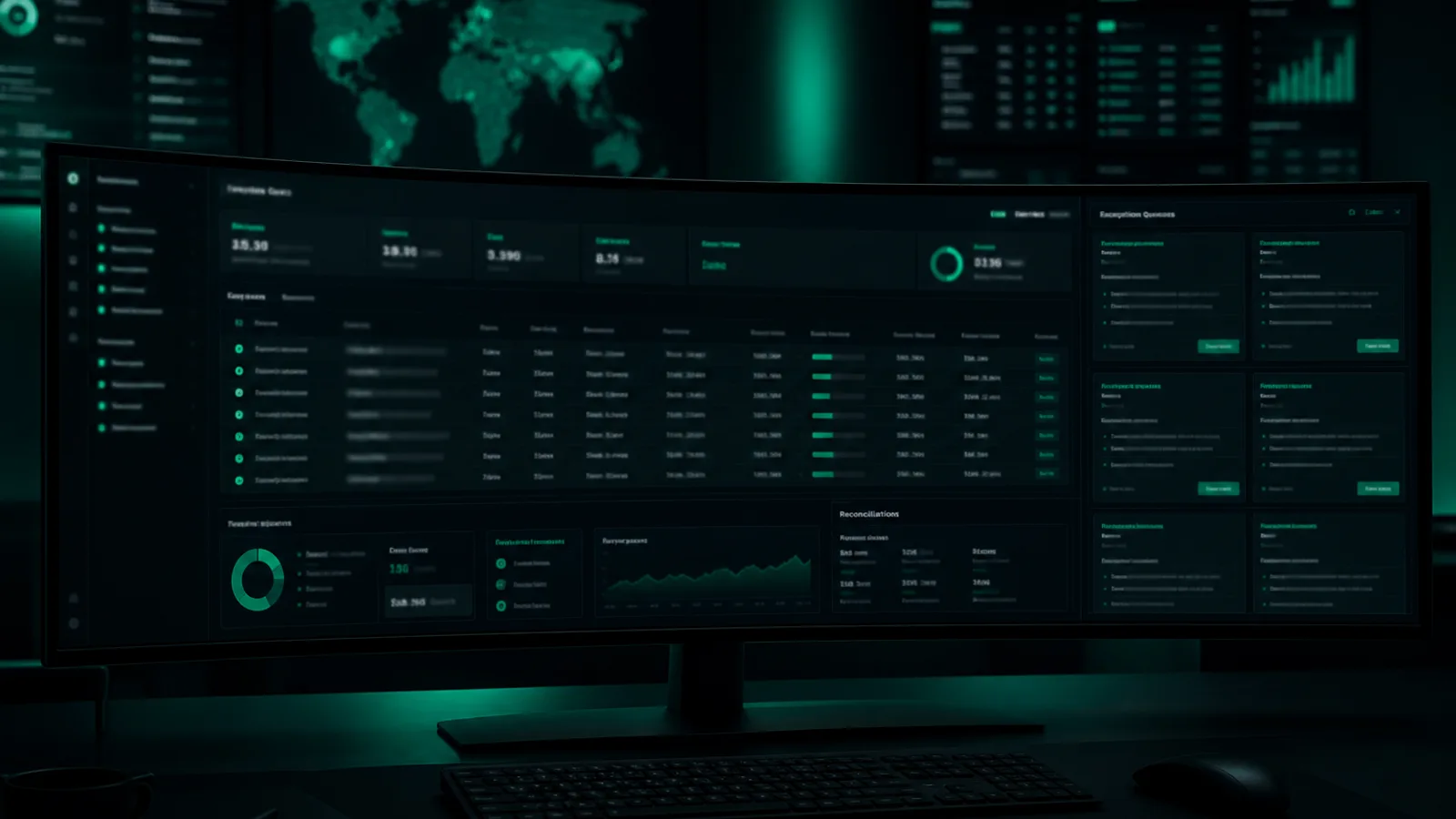
This concept shows how payment rails, exceptions, and compliance queues can become a coherent control center for ops and risk teams.
Payments ledger concept
Fintech · Case of record
A representative concept exploring workflows, system boundaries, and product decisions. It does not claim a named client or performance result.
Motive
Ops and compliance chase the same payment across provider consoles, spreadsheets, and incomplete webhook trails.
When money moves across rails, teams need one reviewable narrative—state, owner, and evidence—so exceptions close without tribal knowledge.
A shared ledger-and-case surface where operators act and reviewers can reconstruct why a payment moved.
Ingest provider payloads into an explicit payment state machine instead of flattening every rail into pending or failed.
Open cases with mandatory ownership and SLA so stuck payments do not age into side channels.
Keep notes, approvals, and provider artifacts on the same case ops and compliance already work from.
Product principles
Fintech actors
Operators, compliance, finance, and risk partners all touch the same payment lifecycle at different moments. The product works when each role sees one case timeline instead of a private console trail.
InterfaceWorks the exception queue on the shared payment timeline—claiming cases, advancing state, and recording decisions against the ledger narrative.
System shape
Rail adapters feed a ledger and case store; exception queues route work to ops and compliance with evidence attached.
Technology map
Why these layers show up in the concept—not a shopping list of logos. Browse the full catalog.
Strong typing across rail payloads and case workflows reduces ambiguous state handling in ops surfaces.
Relational cases plus an append-friendly event trail support reconciliation and audit reconstruction.
Provider adapters should normalize rail-specific states without inventing a second ledger of truth.
Approvals and artifacts stay bound to the case so review packs are not rebuilt from chat logs.
Partial provider failure is expected; workers own redelivery and dead-letter paths explicitly.
Design signals
Illustrative product targets for planning conversations—not measured client results.
3–5
Rails in v1
Start with the money paths that already create the most ops drag.
1
Shared case model
Ops and compliance read the same payment narrative and evidence pack.
<15m
Ownership window
Exceptions should get an owner before they age into tribal knowledge.
100%
Evidence attached
Notes and approvals stay on the case—not in side spreadsheets.
Comparison chart
Relative drag before vs after a shared case model—planning sketch, not a benchmark.
Focus mix
Where early engineering and product time should concentrate.
The operating problem
Modern money movement rarely sits on a single provider. Cards, ACH, wallets, bank rails, and payout networks each emit their own statuses, identifiers, and failure modes. Authorized, settled, reversed, delayed, and disputed are not interchangeable, yet many products flatten them into a generic success or pending badge. Operators then live in provider consoles, spreadsheets, and chat threads trying to rebuild what actually happened.
Compliance and risk review need the same underlying evidence, but often receive a different tool with a delayed export. Approvals, notes, and case decisions drift away from the payment event they explain. When a dispute or unusual pattern appears, teams waste cycles reconciling screenshots instead of deciding the next operational step.
The product failure is not missing dashboards. It is missing a shared model of payment state, exception ownership, and audit attachment. Without that model, every new rail adds another parallel workflow and the operational tax compounds.
The product approach
This concept builds an operations and review layer above systems of record and provider feeds. Rail adapters ingest events idempotently, preserve original provider status, and normalize into an explicit state machine. An operational ledger view presents a rail-aware activity stream with reconciliation signals, not a pretend single balance engine.
Exception queues make ownership unavoidable: who owns the case, what blocked it, what evidence is missing, and how urgent it is. Compliance reviewers work from the same payment timeline with permissioned screens and evidence packs that attach notes, approvals, and history to the event. Partial provider failure, duplicate webhooks, and late settlements are treated as normal inputs, not rare incidents.
Scope starts with the rails that already create the most operational drag. The product observes and reconciles before it ever claims to write authoritative balances. New providers plug into the same case model so growth does not invent a second control center.
Product judgment
When rails, exceptions, and review tools disagree, teams reconstruct history instead of resolving cases. A coherent operational picture reduces that tax by keeping status, ownership, and audit evidence attached to one payment narrative across providers.
Authorized, settled, reversed, delayed, and disputed must remain distinct or reconciliation debt appears silently.
Ambiguous status maps are a product bug, not a data inconvenience. Each rail needs a documented translation into the shared state machine, including terminal states and reversible transitions. When the UI collapses nuance into pending, operators cannot prioritize work and automated reconciliation invents false matches. Preserve provider originals beside normalized state so investigations never lose source truth.
Queues should show who owns a case, what blocked it, and what evidence is missing before SLA pressure builds.
Unowned exceptions age into write-offs, customer harm, and audit findings. The worklist is the product: severity, blocker taxonomy, assignee, and next action must be visible without opening five tools. Escalation rules belong in the queue model, not in tribal knowledge. If ownership can be empty, it will be empty at the worst moment.
Notes, approvals, and event history belong with the payment case, not in side spreadsheets or chat threads.
Review quality collapses when evidence is reconstructed after the fact. Every operational decision should leave an immutable trail tied to the payment identifiers and state transition it concerned. Compliance screens can differ in permission and layout, but they must read the same case record. Parallel copies recreate the fragmentation this product exists to remove.
Webhook gaps, duplicates, and delayed settlements are normal; the product must detect and reconcile them.
Happy-path integrations fail in production. Ingest must be idempotent, originals preserved, and mismatches surfaced as work items rather than silently overwritten. Timeout and retry policy should be visible to operators. A dashboard that assumes perfect feeds trains teams to distrust every status indicator the first time a provider stalls.
Normalization helps operations, but erasing rail and provider context makes investigation and customer response harder.
Operators need to know which rail produced an event, which merchant or payout account is implicated, and which external reference IDs are needed to open provider support. The shared timeline should normalize meaning without flattening identity. Deep links or reference packs to provider artifacts shorten mean time to resolution without forcing people to live in those consoles.
Not every status change deserves a queue item; severity and taxonomy prevent alert fatigue from burying real risk.
If every delayed webhook becomes a page, teams mute the system. Define which transitions auto-resolve, which become informational, and which require human ownership. Compliance-sensitive patterns can share the same evidence base while using different severity and routing. Queue design is risk design, not cosmetic prioritization.
Operational flow
A representative path showing how multi-rail ingestion becomes a shared ops and compliance workflow.
Flow at a glance
Step 01
Adapters accept webhooks or pulls, store originals, and map provider status into the shared payment state machine.
ArtifactNormalized event record with provider original payload
Step 02
The operational ledger compares new events to prior state, detecting duplicates, gaps, and illegal transitions.
ArtifactReconciliation signal and mismatch diagnosis
Step 03
When human judgment is required, a queue item appears with ownership, severity, blockers, and linked payment context.
ArtifactException case with assignee and blocker taxonomy
Step 04
Operators and reviewers inspect the rail-aware narrative, references, and prior notes without reconstructing history manually.
ArtifactPayment timeline and evidence pack view
Step 05
Resolution actions and compliance decisions write back to the same case so future audits and handoffs stay coherent.
ArtifactDecision record with approval and audit history
Layer decisions
Provider-specific intake that normalizes events while preserving original status, identifiers, and payloads.
Rail-aware activity stream, reconciliation signals, and exception cases sitting above systems of record.
Prioritized worklists for failures, mismatches, and compliance cases with SLA and blocker context.
Role-aware interfaces for investigation, approvals, notes, and evidence packaging on one payment narrative.
Traps to avoid
Over-normalized badges hide reversible states and dispute paths, so operators cannot prioritize and reconciliation invents false certainty.
Worklists that allow orphaned cases become graveyards. SLA dashboards then report volume while nothing moves.
Separate exports drift from operational truth. Reviews then certify a history that ops no longer believes.
Silent overwrite on late or duplicate webhooks destroys auditability. Mismatches must become visible cases, not background corrections.
How we would approach it
Phase 1
Choose the first rails, define shared payment states, and clarify whether the product observes, reconciles, or ever writes balances.
Phase 2
Ship idempotent adapters, preserved originals, and an operational timeline that surfaces mismatches.
Phase 3
Turn mismatches and failures into owned work with severity, blockers, and escalation rules.
Phase 4
Add review workflows on the shared case model, then onboard additional rails without inventing parallel dashboards.
Conceptual outcomes
These are product outcomes to design toward, not claimed client results.
Operators and reviewers share a coherent timeline instead of competing provider screenshots and spreadsheet reconstructions.
Cases arrive with ownership, blockers, and enough context to decide the next step without tool-hopping.
Approvals, notes, and history stay attached to the payment event they explain for ops and compliance alike.
New rails plug into the same operational model without inventing a parallel dashboard or review process.
Discovery checklist
Decision guide
Limit early complexity to the money-movement paths that already create the most operational and review drag.
Clarify whether this layer observes, reconciles, or ever writes authoritative balances, and keep that boundary explicit in the product.
Agree case types, severity rules, ownership, and escalation before investing in queue interfaces or automation.
Common questions
Answers about this fintech product concept and how SolveMotive approaches similar work.
No. It is a representative product concept. It does not claim a client identity, completed engagement, or performance result.
The concept is provider-agnostic. Real engagements map specific APIs, webhooks, and reconciliation rules for the rails you use.
Not by default. It is framed as an operations and review layer that sits on top of systems of record and provider events.
Not by default. It is framed as an operations and review layer that sits on top of systems of record and provider events. Authoritative balance ownership stays with the systems your finance architecture already designates.
Ingest idempotently, preserve originals for audit, and reconcile against expected state transitions. The UI should surface unresolved mismatches as owned work rather than silently overwrite history.
They can use different permissions and screens, but they should share the same underlying payment evidence. Parallel data copies usually recreate the fragmentation this product is meant to remove.
Still stuck on a specific constraint? Book a scoping call →
Clear, dependable financial product experiences for teams operating in a high-trust environment.
Purpose-built software for complex workflows, products, and operational systems.
A product concept connecting multi-chain lending logic with a clear borrower and lender dashboard.