
3
Actor loops
Customer, kitchen, and courier states stay coherent on one order model.

SolveMotive
From motive to operable release
Product concept
This use case shows how customer ordering, restaurant operations, courier activity, and real-time status can work as one platform.
Marketplace loop concept
A representative concept exploring workflows, system boundaries, and product decisions. It does not claim a named client or performance result.
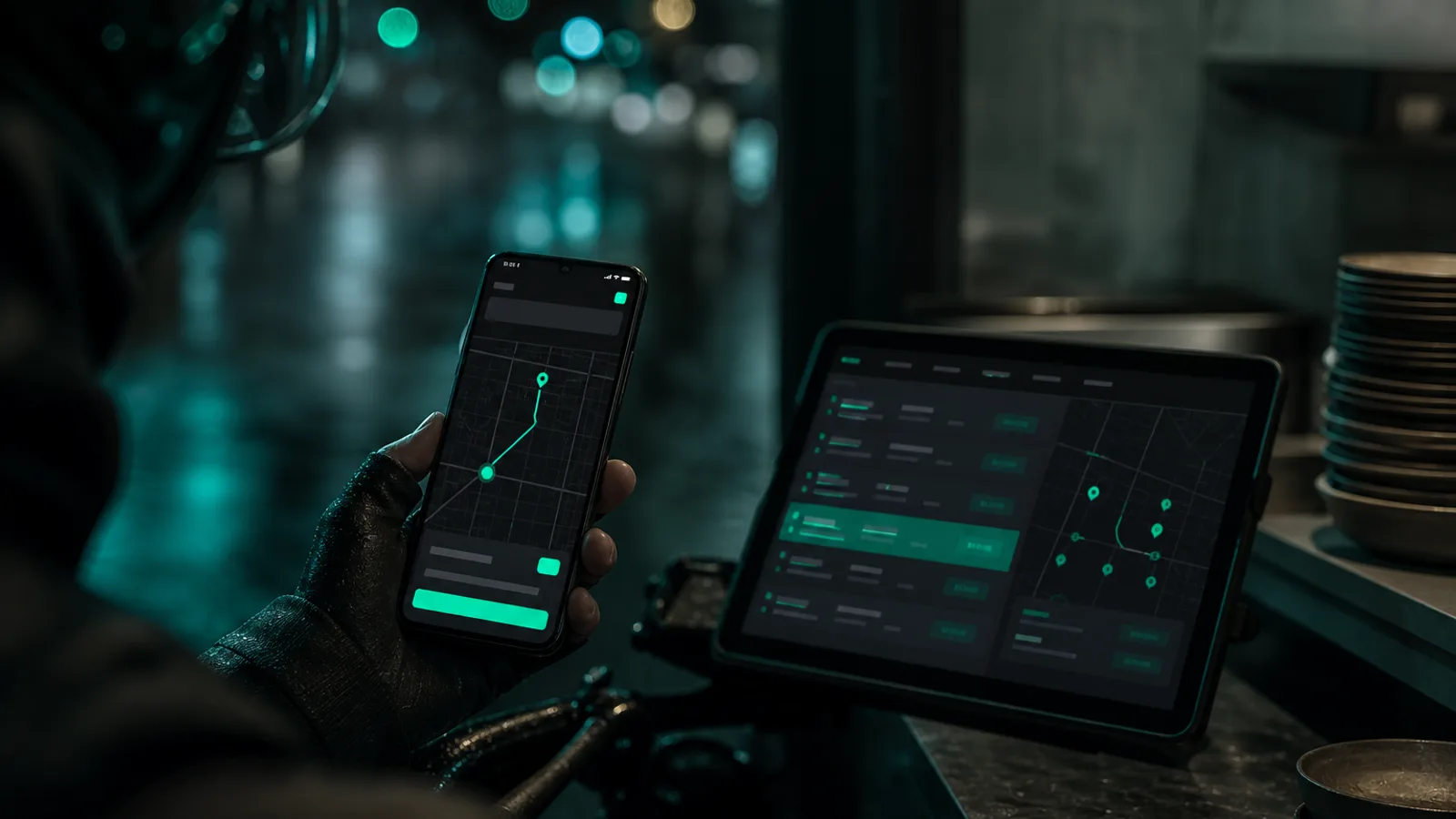
Stack · Flutter · Node.js · Firebase · Stripe
Motive
Customer, kitchen, and courier apps diverge when order truth is reconstructed from notifications and provider callbacks.
Delivery products need one order lifecycle that each role can advance safely—with recovery paths for payment and assignment failure.
A multi-party order system where notifications support state and exceptions close on one timeline.
Model the full lifecycle before shipping three apps so every role reads the same state machine.
Expose only the actions that are valid now for customers, kitchens, couriers, and support.
Treat payment, assignment, and late events as recoverable product states—not afterthoughts.
Product principles
Mobile App actors
Customers, restaurant teams, couriers, and support each change order state under different constraints. The platform succeeds when one lifecycle governs those role-scoped actions.
InterfaceAdvances checkout and tracks order state through the customer app; push updates reflect the shared machine rather than inventing status.
System shape
An order state machine sits at the center of customer, kitchen, and courier clients, with payments, maps, and notifications as supporting planes.
Technology map
Why these layers show up in the concept—not a shopping list of logos. Browse the full catalog.
Customer, kitchen, and courier experiences share one mobile foundation with role-limited actions.
The order state machine must be server-owned so three clients cannot invent conflicting lifecycles.
Realtime updates and pushes support state changes; they must not become the system of record.
Checkout, refunds, routing, and ETA need clear ownership when payment or assignment fails mid-run.
Design signals
Illustrative product targets for planning conversations—not measured client results.
3
Actor loops
Customer, kitchen, and courier states stay coherent on one order model.
Sync
State machine
Late kitchen and courier events are normal inputs, not rare failures.
ETA
Promise honesty
Promises degrade gracefully when reality shifts mid-order.
Ops
Recovery path
Refunds, reassignments, and support share the same order narrative.
Comparison chart
Relative inconsistency before vs after a shared order model—planning sketch only.
Actor attention
The operating problem
On-demand food delivery looks like a set of mobile screens, yet the product breaks when customer, restaurant, and courier clients invent their own order timelines. Payment webhooks, kitchen updates, assignment changes, and GPS pings arrive late, duplicate, or out of order. Without a canonical lifecycle, each role improvises status language and support inherits conflicting screenshots.
Peak hours amplify the damage. Unavailable menu items still reach checkout, couriers chase already-cancelled pickups, and restaurants accept tickets they cannot fulfill. Notifications try to paper over the gaps, but push delivery is not authoritative state. The core failure is product ownership of order truth, not the absence of another map animation.
The product approach
Start with explicit states, transitions, cancellation rules, and role-scoped actions for every stage from checkout to delivery or refund. Build customer, kitchen, and courier experiences as projections of that contract rather than parallel data models. Treat notifications as supporting signals that can lag, while in-product status remains the source of truth.
Design for late and duplicate events from day one. Idempotent handlers, payment capture rules, and exception playbooks should define who can act when a courier no-shows, a kitchen rejects late, or a card capture fails. That foundation lets a first geography launch with menus, dispatch, and support that can expand without rewriting the order core.
Product judgment
Customers, restaurants, and couriers each see a different slice of the same order. If those slices drift, support load rises and trust collapses.
Screen design comes after states, transitions, and cancellation rules are explicit for every role.
Teams often start with customer browsing and courier maps because those surfaces feel tangible. Without a shared lifecycle, each client encodes different assumptions about when an order is confirmed, preparing, assigned, or closed. Write the state machine and allowed transitions first, including who may cancel and what money movement follows. Apps then become role-scoped views of one contract instead of three competing products.
Push alerts can lag or fail, so in-product status must remain authoritative when a message is missed.
Customers and couriers will miss notifications during busy periods or after OS permission changes. If the product treats a push as the only update mechanism, people operate on stale belief. Keep the order detail screen current through server truth, with push as a prompt to reopen that truth. Support scripts should also point to the shared timeline rather than asking which alert someone last saw.
Payment webhooks, GPS pings, and kitchen updates arrive out of order, so idempotent handling prevents phantom statuses.
Realtime systems in delivery are noisy. A payment success may land after a timeout retry, or a courier location update may arrive for an already reassigned order. Model events with stable identifiers and ignore or merge duplicates without flipping status backward into illegal states. The UI should explain recoverable delays without inventing a second history that support cannot reconcile.
Overloading restaurants or couriers with irrelevant controls creates mistakes at the moments that hurt most.
Kitchen staff under ticket pressure do not need customer marketing controls, and couriers mid-route do not need full refund tooling. Scope actions to the current lifecycle stage and role permissions. Fewer, clearer controls reduce accidental rejects, wrong mark-ready taps, and premature delivered states. Exception paths can escalate to support instead of exposing every override to every participant.
Availability must fail closed quickly at peak hours, with clear ownership for what can be sold right now.
A beautiful menu catalog that sells out-of-stock items creates cancellations and refunds at the worst time. Availability belongs to restaurant operations with fast propagation into checkout. When freshness is uncertain, block the item rather than letting customers pay for something the kitchen will refuse. Pair 86ing workflows with confirmation in the restaurant client so ownership of the truth is visible.
Assignment rules encode geography, courier density, and ops maturity long before matching quality becomes a tuning exercise.
Manual assignment, algorithmic matching, and hybrid models each imply different UI and exception paths. Early markets often need operator override when courier supply is thin or restaurants cluster unevenly. Encode who can reassign, what happens on no-show, and how ETA promises change after reassignment. Shipping a black-box matcher without those policies leaves support improvising during every incident.
Order flow
A durable delivery platform keeps every role aligned to one order timeline from payment through prep, assignment, handoff, and exception handling.
Flow at a glance
Step 01
The customer builds an order against live menu and zone constraints so unavailable items never reach a payable cart.
ArtifactAvailability-aware cart with zone eligibility checks
Step 02
Checkout creates a single order record with payment linkage, restaurant acceptance window, and initial customer-visible status.
ArtifactOrder contract with payment and acceptance timers
Step 03
Kitchen tools show only actionable tickets, with accept, reject, and prep updates that write back to the shared lifecycle.
ArtifactRole-scoped kitchen queue tied to order states
Step 04
Dispatch assigns pickup, courier steps stay synchronized with prep readiness, and customers see progress without a second status model.
ArtifactAssignment record with pickup and dropoff checkpoints
Step 05
Delivery confirmation, cancellations, and disputes resolve against the same history support can replay for every role.
ArtifactUnified order timeline with exception playbook links
Layer decisions
Canonical lifecycle, payments linkage, and role-scoped projections for customer, kitchen, and courier views.
Event fan-out for status changes with fallbacks when sockets or push delivery are delayed.
Provider adapters for checkout, refunds, geocoding, and routing with explicit failure recovery.
Customer, courier, and restaurant clients built around the same order contract, not parallel data models.
Traps to avoid
Parallel data models create conflicting statuses that no amount of notification copy can reconcile during incidents.
Missed alerts become missed truth. In-product status must stand alone when notifications lag or fail.
Peak-hour cancellations and refunds follow when checkout trusts stale menus instead of operational 86 state.
Without clear reassignment, no-show, and refund policies, support improvises while customers and restaurants wait.
How we would approach it
Phase 1
Define lifecycle rules, launch geography constraints, and the minimum restaurant onboarding path.
Phase 2
Make catalog availability and payment capture trustworthy before expanding realtime flourish.
Phase 3
Connect prep advancement to assignment and handoff with role-scoped actions only.
Phase 4
Harden shared history, exception playbooks, and the seams needed for a second geography.
Conceptual outcomes
These are product outcomes to design toward, not claimed client results.
Every role can reconstruct what happened from one shared history instead of conflicting screenshots.
Coverage, menus, dispatch rules, and support playbooks can launch in one geography without painting the architecture into a corner.
Payment failures, courier no-shows, and cancellations have defined owners and next actions.
Support and ops can see bottlenecks in prep, assignment, and delivery without inventing side spreadsheets.
Discovery checklist
Decision guide
Decide which zones, SLAs, and restaurant onboarding constraints define the first market.
Choose manual assignment, algorithmic matching, or a hybrid based on courier density and ops maturity.
Clarify when funds capture, when refunds are automatic, and who can override during disputes.
Common questions
Answers about this mobile app product concept and how SolveMotive approaches similar work.
No. It is a representative product concept showing possible workflows and engineering considerations. It does not claim a client identity, completed engagement, or verified outcome.
Yes. Geographic coverage, restaurant onboarding, delivery rules, payments, and support operations can be scoped for an initial market while preserving a path to expansion.
The implementation can combine server-side order state, event-driven updates, push notifications, and location services, with fallbacks for delayed connectivity.
They can share design systems and domain clients, but each role usually needs its own navigation, offline assumptions, and permission model. Shared code should not force shared UX.
Treat availability as operational state with clear ownership. Restaurant updates should propagate quickly, and stale items should fail closed rather than let customers checkout unavailable options.
Start with authoritative server state, push for important transitions, and polling fallbacks. Expand to richer live tracking once the order contract and exception handling are stable.
Still stuck on a specific constraint? Book a scoping call →
Connected ordering, delivery, and restaurant operations experiences for food businesses.
Operational software that helps teams coordinate movement, status, exceptions, and decisions.
Thoughtful iOS and Android applications designed around the mobile context.