

Surface
If your product moves value, key management is not an infrastructure footnote—it is part of the product. Customers feel it in withdrawal latency, recovery friction, and whether a single compromised laptop can empty a hot wallet. Regulators feel it in custody narratives. Attackers feel it as the shortest path to cash.
This essay sits after crypto threat modeling for fintech and before post-quantum migration. You choose HSM, MPC, or a hybrid to match the threats you ranked—and you design those choices to stay crypto-agile when algorithms change.
What you are really choosing
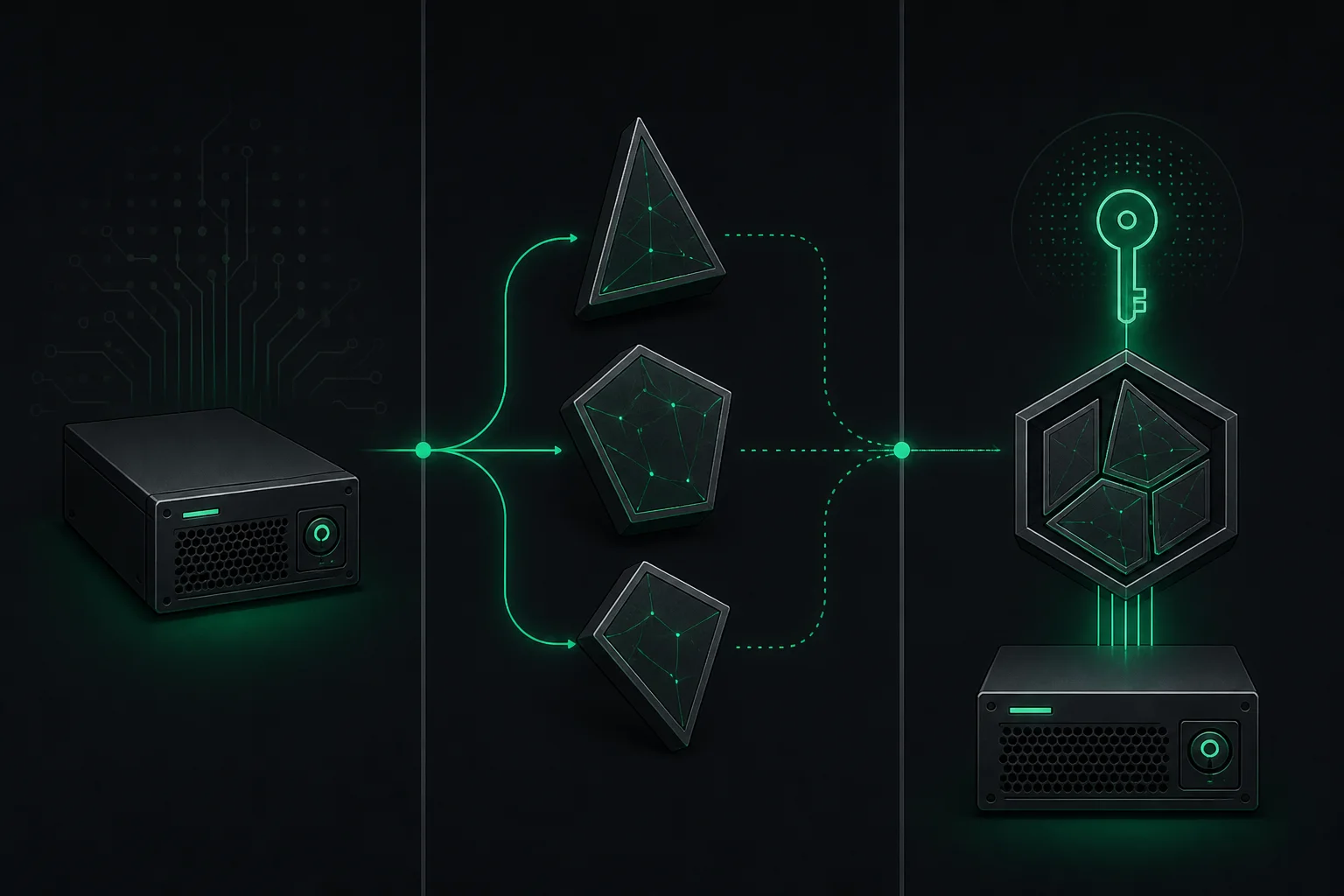
All serious designs try to prevent one person, one server, or one vendor from unilaterally signing. They differ in where secret material lives, how policy is enforced, and what breaks during an outage.
Hardware security modules (HSMs)
HSMs keep key material in hardened hardware with authenticated policy: which keys exist, which operations are allowed, and which identities can approve them. They shine when you need strong physical protection, established audit stories, and tight integration with payment or PKI workflows.
Tradeoffs: procurement and change control can be slow; multi-region active-active designs need care; algorithm agility depends on firmware and vendor roadmaps—especially relevant as NIST’s ML-KEM / ML-DSA / SLH-DSA suite rolls into products.
Multiparty computation (MPC)
MPC splits signing so no single machine holds a complete private key. Shares live with different services, clouds, or organizations. Compromising one share should not yield a usable key. MPC is attractive for geo-distributed custody, exchange-style withdrawal pipelines, and teams that want software-defined policy without shipping every key into a single appliance.
Tradeoffs: protocol complexity, careful identity for share holders, and the need to rehearse share refresh and disaster recovery. “MPC” on a marketing page is not the same as a threshold policy you can explain to an auditor.
Hybrids
Common pattern: HSM-backed roots or seed ceremonies, MPC for online signing quorums, and cold processes for high-value moves. Hybrids acknowledge that one tool rarely matches every risk tier.
Compare on operations, not only cryptography
| Criterion | HSM-centric | MPC-centric | Hybrid |
|---|---|---|---|
| Unilateral signing resistance | Strong with dual control + policy | Strong with honest-threshold assumptions | Tunable by tier |
| Algorithm agility | Vendor firmware / FIPS path dependent | Often software-updatable shares/protocols | Mix; plan dual-run early |
| Latency for hot paths | Typically excellent once wired | Network round-trips between parties | Hot path via MPC or HSM as designed |
| Audit narrative | Mature in banking contexts | Growing; document quorum & refresh | Map each tier explicitly |
| Outage mode | Appliance / cluster failure | Party or network partition | Fail closed per policy |
| Typical fit | Issuing, PKI, card-adjacent, roots | Exchange wallets, distributed custody | Tiered withdrawals & governance |
IBM’s breach-cost research still frames why this table matters: whether the global average is $4.88M or about $4.44M, a custody incident is rarely “average.” Design for the loss you cannot absorb.
Controls that matter more than the brand
1. Policy as code and ceremony. Who can create keys, set thresholds, approve withdrawals, and export anything at all? 2. Dual control and break-glass. Emergency paths should be slower and louder than normal paths. 3. Share or backup refresh. Stale disaster-recovery material is a second production system you forgot you had. 4. Observability. Signing anomalies, quorum changes, and policy edits need alerts with owners. 5. Crypto-agility hooks. Algorithm identifiers, key versions, and dual-verify windows so PQC or curve migrations do not require rewriting the wallet service.
For on-chain products, remember that key architecture sits beside product architecture. If shared verification is not actually required, blockchain may be the wrong house to retrofit locks into. If AI tooling can trigger or recommend signed actions, keep models off the authoritative signing path per AI and on-chain data boundaries.
A decision sequence you can run in a week
- Rank withdrawal, governance, and archive risks from your threat model
- Split keys into tiers (hot / warm / cold) with different latency and approval rules
- For each tier, pick HSM, MPC, or hybrid and write the outage behavior
- Prove a dry-run key rotation and a simulated party or appliance loss
- Record evidence for compliance readers—especially if you operate as or with MiCA CASPs
Next: how to migrate algorithms—including post-quantum suites—without freezing withdrawals for a quarter. Then we close the loop with compliance as crypto architecture.