
Surface
The editor lies politely. A green run with sample data is not production. Production is partial failures, duplicate webhooks, rate limits, and the Tuesday when a credential expires at 2 a.m. If your n8n workflow cannot answer what happens on retry, who gets alerted, and which steps need a human, it is not ready to own real side effects.
This is the same discipline we argue for in agentic AI workflows: permissions, auditability, and checkpoints. The runtime is n8n instead of an LLM agent loop. The failure modes rhyme.
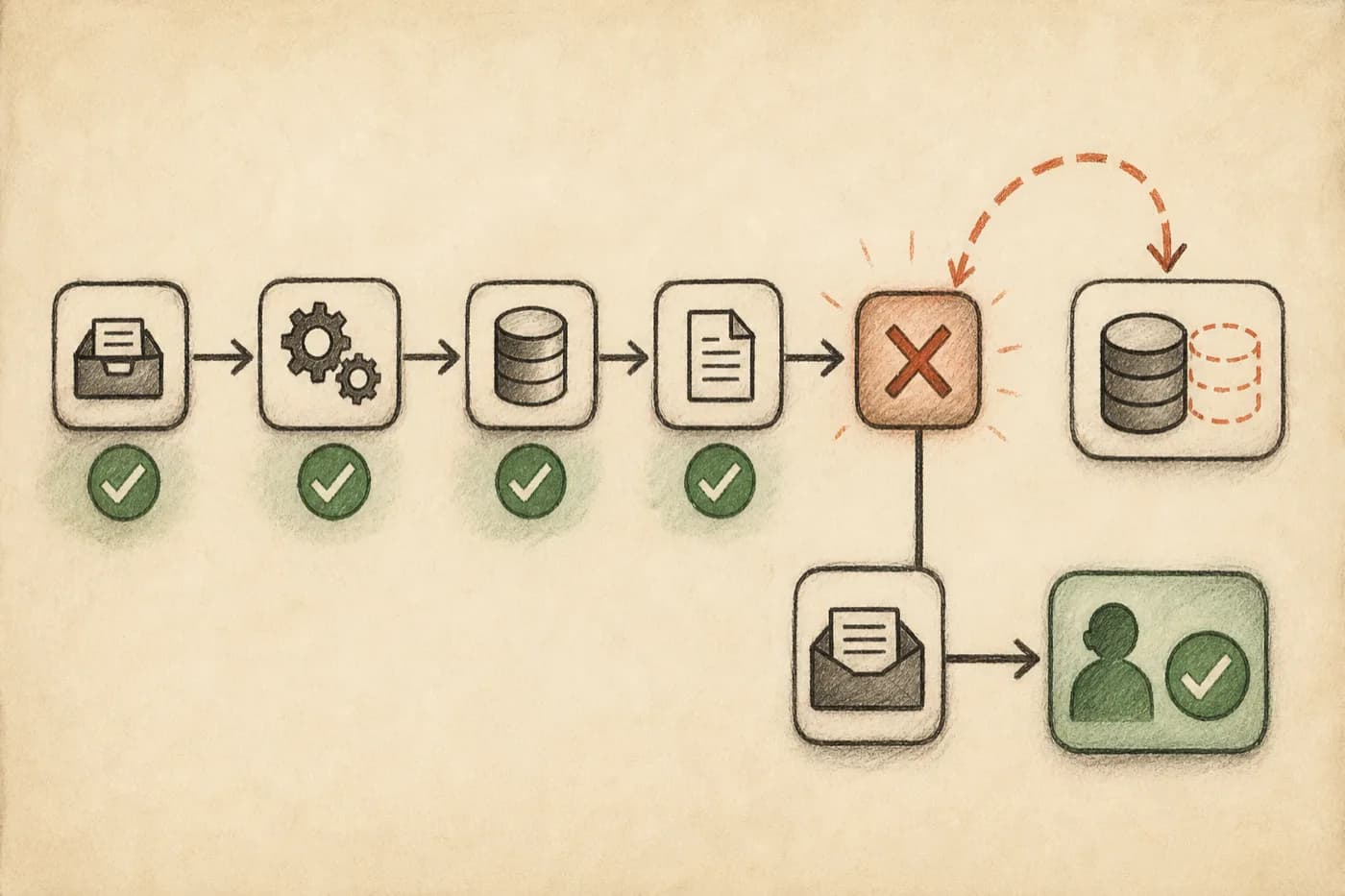
Failure modes that show up after the demo
Partial completion
Node three succeeds (CRM updated) and node five fails (email not sent). A naive retry creates a second CRM update or a confusing half-state. Design each side effect to be safe under replay, or compensate explicitly.
Duplicate triggers
Webhooks double-fire. Schedules overlap after a backlog. Queue consumers redeliver. Without an idempotency key or dedupe store, you bill twice, notify twice, or open duplicate tickets.
Silent skips
A branch condition filters everything into a dead path. Nobody notices because nothing "errored." Volume dashboards and "expected vs actual" counts catch this; green checkmarks do not.
Credential and schema drift
APIs rename fields. Tokens rotate. A workflow that was perfect in January fails quietly in March. Treat credentials and schemas as production dependencies with owners, not set-and-forget config.
Partial failure to safe recovery
- T0
Partial success
CRM write OK · email node fails
- Retry
Unsafe replay
Full rerun risks duplicate side effects
- Safe
Idempotent path
Keyed no-op + dead letter after budget
- Human
Checkpoint
Money / trust / irreversible only
Insight: green in the editor only proves the happy path. Production is the retry story.
Reliability targets worth writing down
Before go-live, agree numbers. Examples we use as starting points for ops glue (tighten for money paths):
| Metric | Starter target | Why it matters |
|---|---|---|
| Success rate (7-day) | ≥ 99% on critical flows | Separates "demo works" from "ops can sleep" |
| Alert on failure streak | Page after 3 consecutive fails or 15 min of errors | Stops silent burn |
| Retry budget | 3–5 attempts with backoff, then dead letter | Caps thundering herds |
| Dead-letter SLA | Human ack within 1 business hour (critical) | Failures need owners |
| Idempotency coverage | 100% of expensive writes keyed | Retries become safe |
| Zero-success anomaly | Alert if expected volume > 0 and successes = 0 | Catches silent skips |
McKinsey has repeatedly found that only a minority of organizations see measurable bottom-line impact from AI despite wide adoption; governance and operating discipline separate pilots from production. Workflow automation follows the same pattern: activity without controls is not results.
Controls that make volume survivable
Idempotency
Decide the natural key for each write: external invoice id, webhook delivery id, CRM record id plus operation name. Persist "already processed" markers where side effects are expensive. Retries should become no-ops when work is done.
Retries with budgets
Retry transient errors with backoff. Cap attempts. After the cap, route to a dead-letter path a human can see. Infinite retries turn outages into thundering herds.
Dead letters and alerts
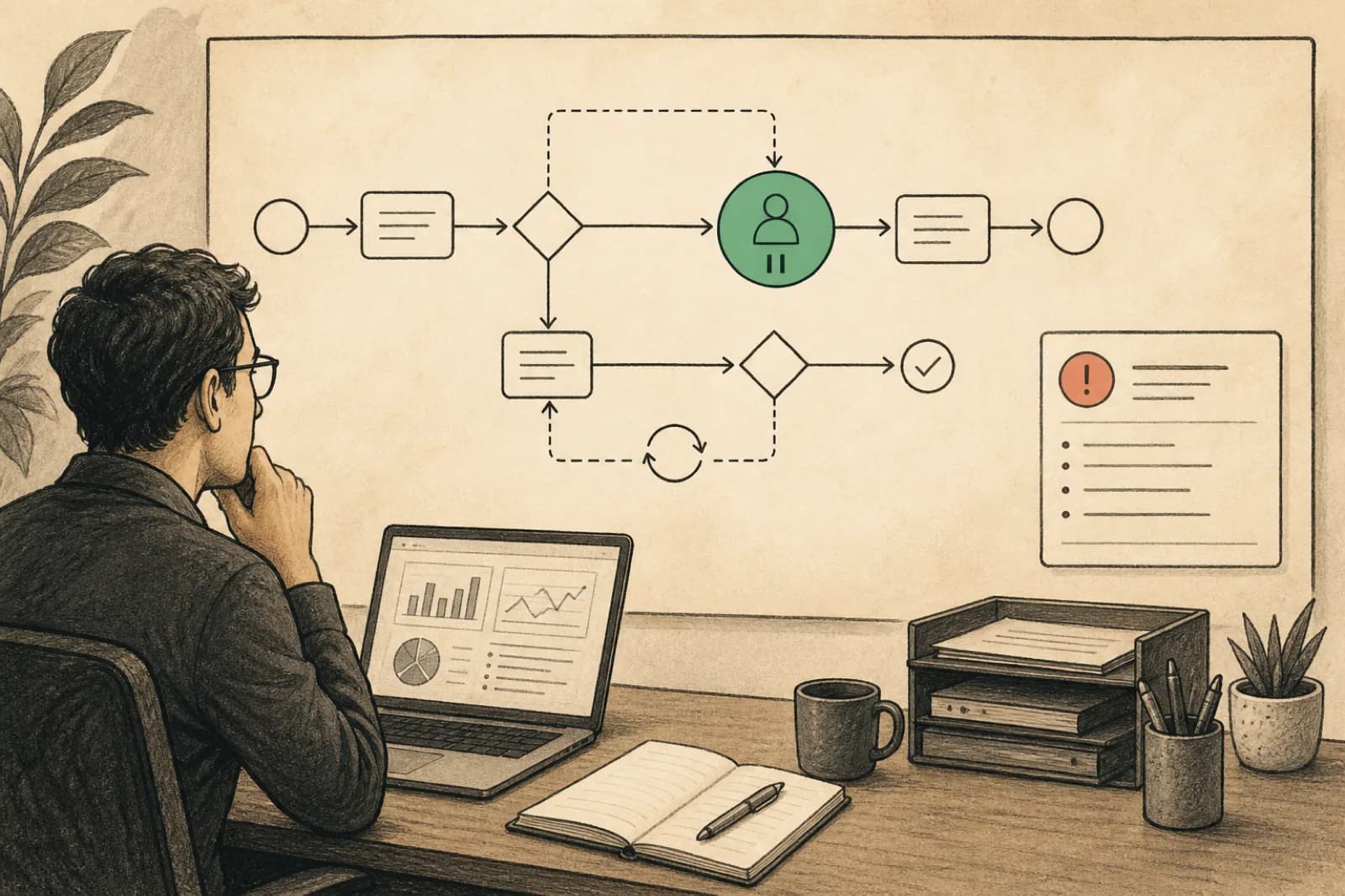
Failed executions need a queue, channel, or ticket someone owns. "Check the execution list when you remember" is not an operations plan. Alert on failure rate and on zero-success anomalies for critical flows.
Human checkpoints
Not every step needs approval. That would erase the point of automation. Reserve humans for:
- Money movement above a threshold
- Customer-visible messages that can harm trust
- Irreversible deletes or permission changes
- Anything your policy or regulator would call out in an incident review
Name those steps in the runbook before go-live. Leave low-stakes enrichment and routing automated within their permission scope.
Runbook ownership before go-live
Before promoting a workflow:
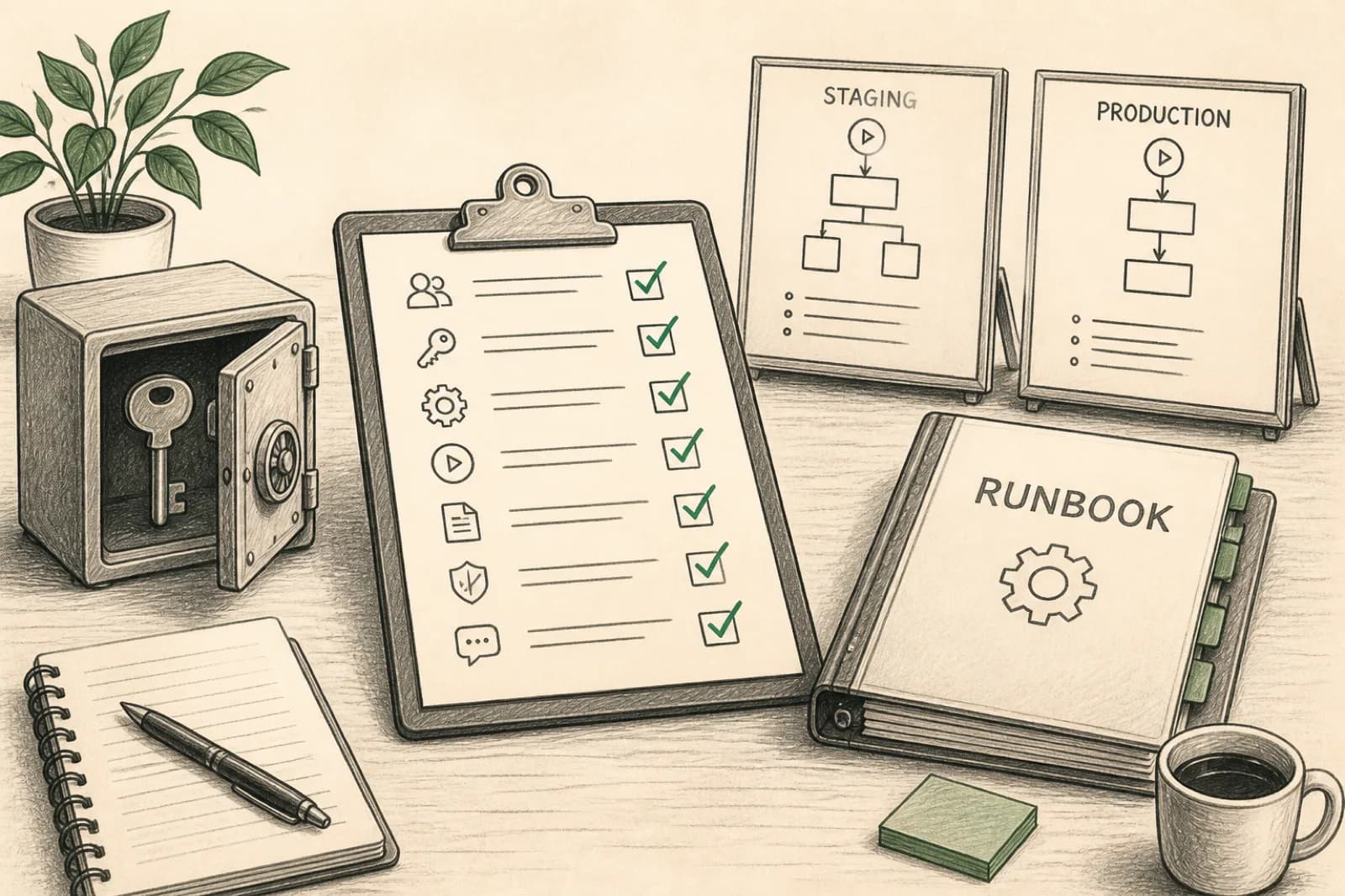
1. Document trigger, happy path, failure path, and rollback in one page 2. Name the primary and backup owner 3. Confirm staging vs production credentials are separated 4. Confirm who can edit production workflows (small set) 5. Confirm alerts land where someone will act
The last essay in this series, who owns the n8n instance after the demo, expands the handoff package. Do not skip it because the canvas looks tidy.
How this connects to choosing the runtime
If you cannot implement idempotency and review for a critical path in n8n without heroic effort, that is a signal to graduate into product code. Tools should fit the reliability bar, not the other way around.
A minimal production checklist
| Control | Question to answer |
|---|---|
| Idempotency | What key makes a retry safe? |
| Retry budget | How many times, with what backoff, then where? |
| Dead letter | Who sees permanent failures within an hour? |
| Checkpoint | Which steps require a human, and who is on the rotation? |
| Alerting | What fires when success count drops to zero? |
| Access | Who can edit prod, and is staging isolated? |
If any row is blank for a workflow that moves money or customer trust, keep it in staging.
For teams pairing automation with broader delivery quality, QA and automation and how we work are the adjacent conversations: workflows are only as trustworthy as the operating cadence around them.