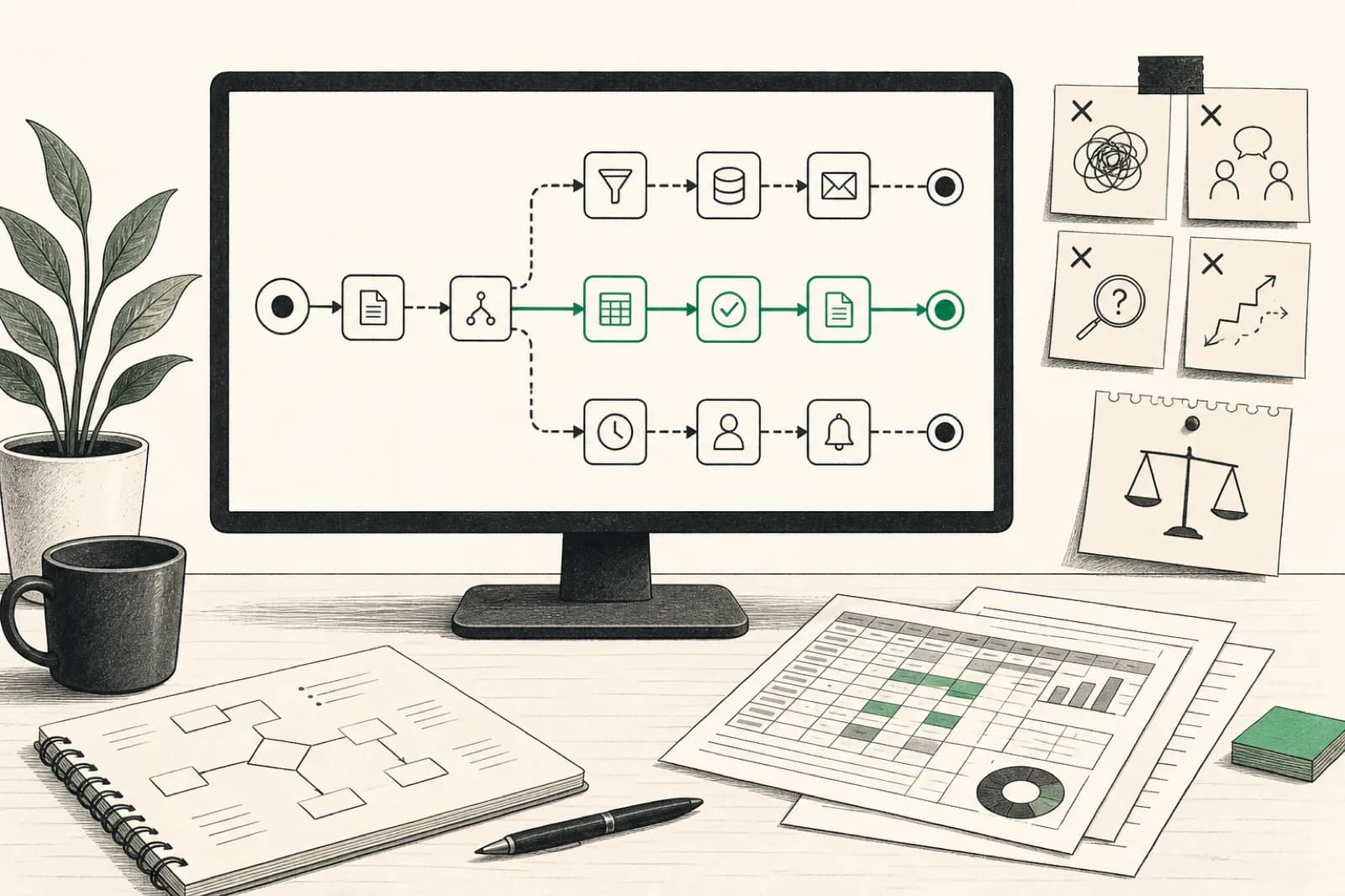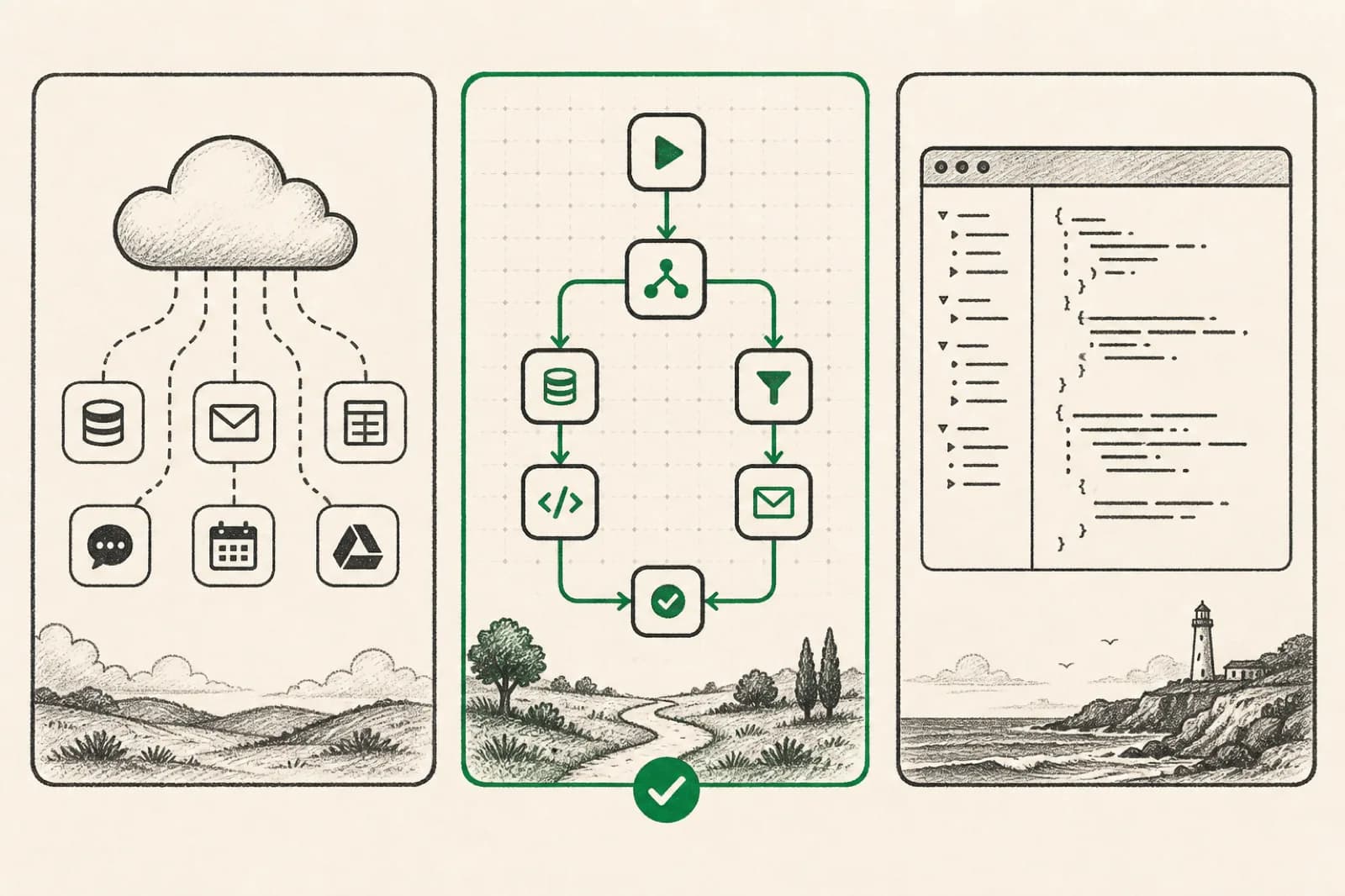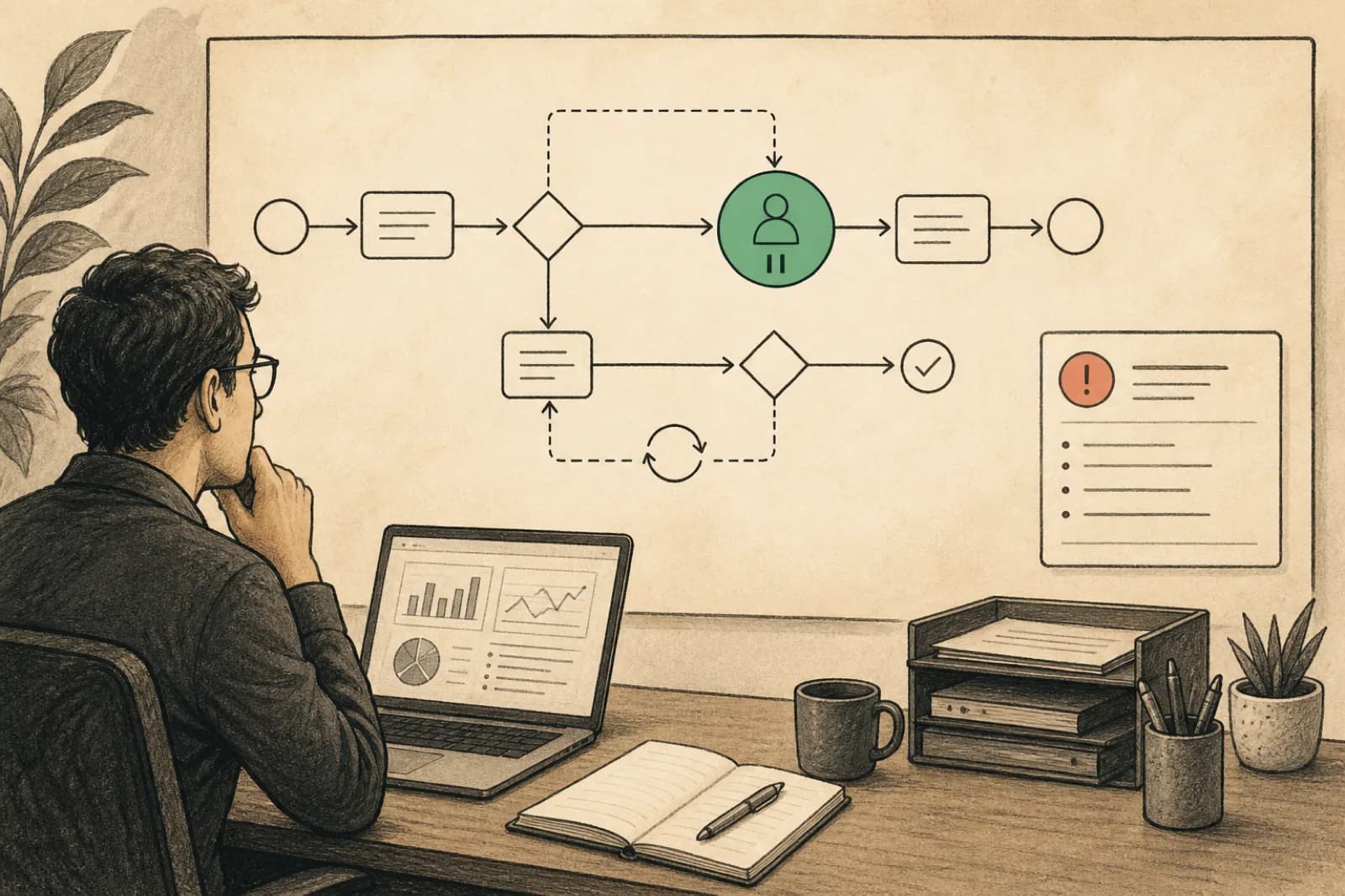

Surface
A demo workflow with one builder's personal API keys is not a delivery artifact. It is a liability with a screenshot. When that builder leaves the channel, the instance becomes folklore: nobody knows which credential is live, who can edit production, or how to roll back last Thursday's "quick fix."
This essay closes the series. You decided what to automate, which runtime, how to fail safely, and how to use AI nodes. Now make it operable by someone who did not draw the first version.
The pattern mirrors AI product ownership after the first demo: runbooks, versioning, and a named owner beat a clever prototype.
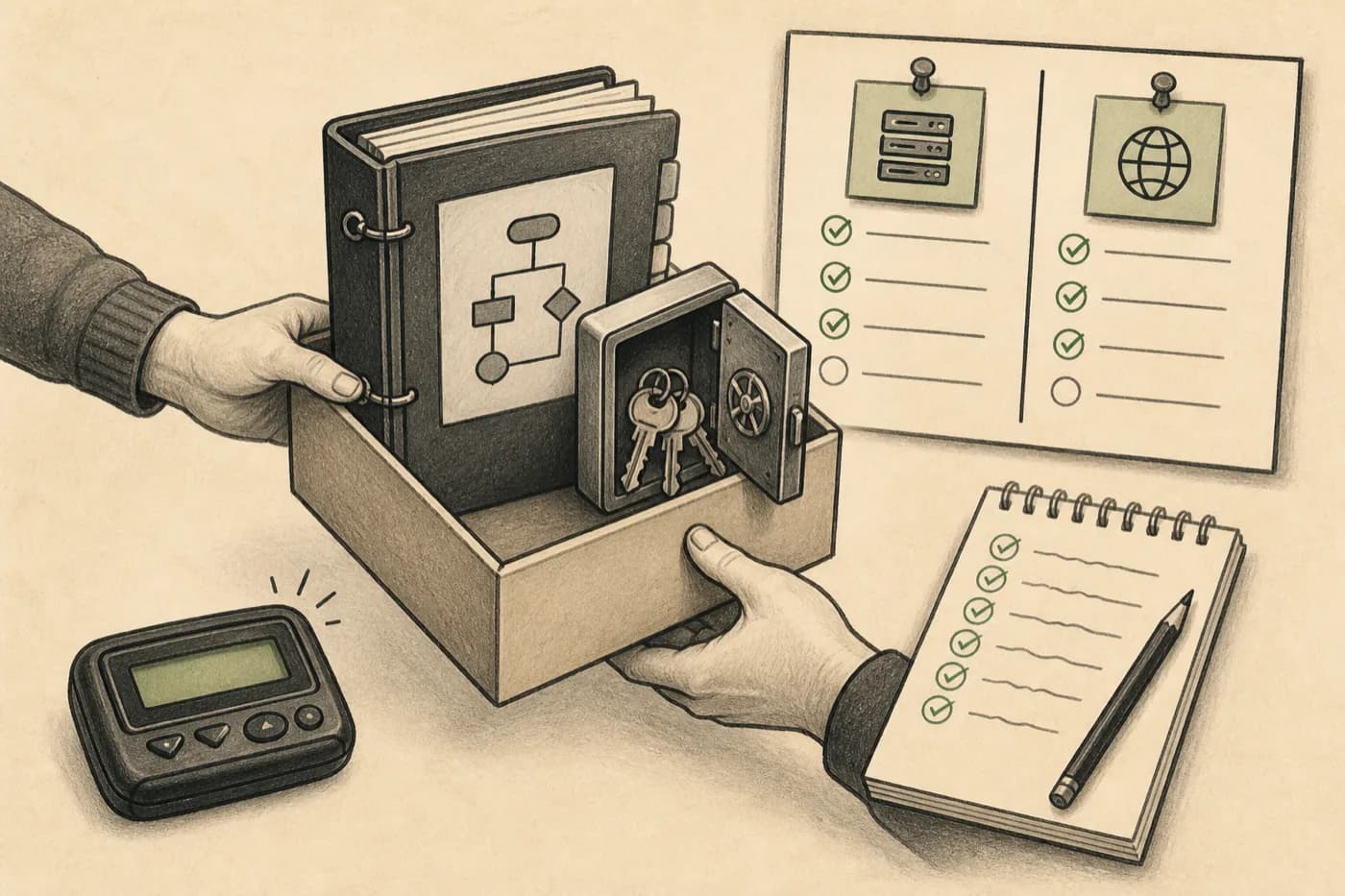
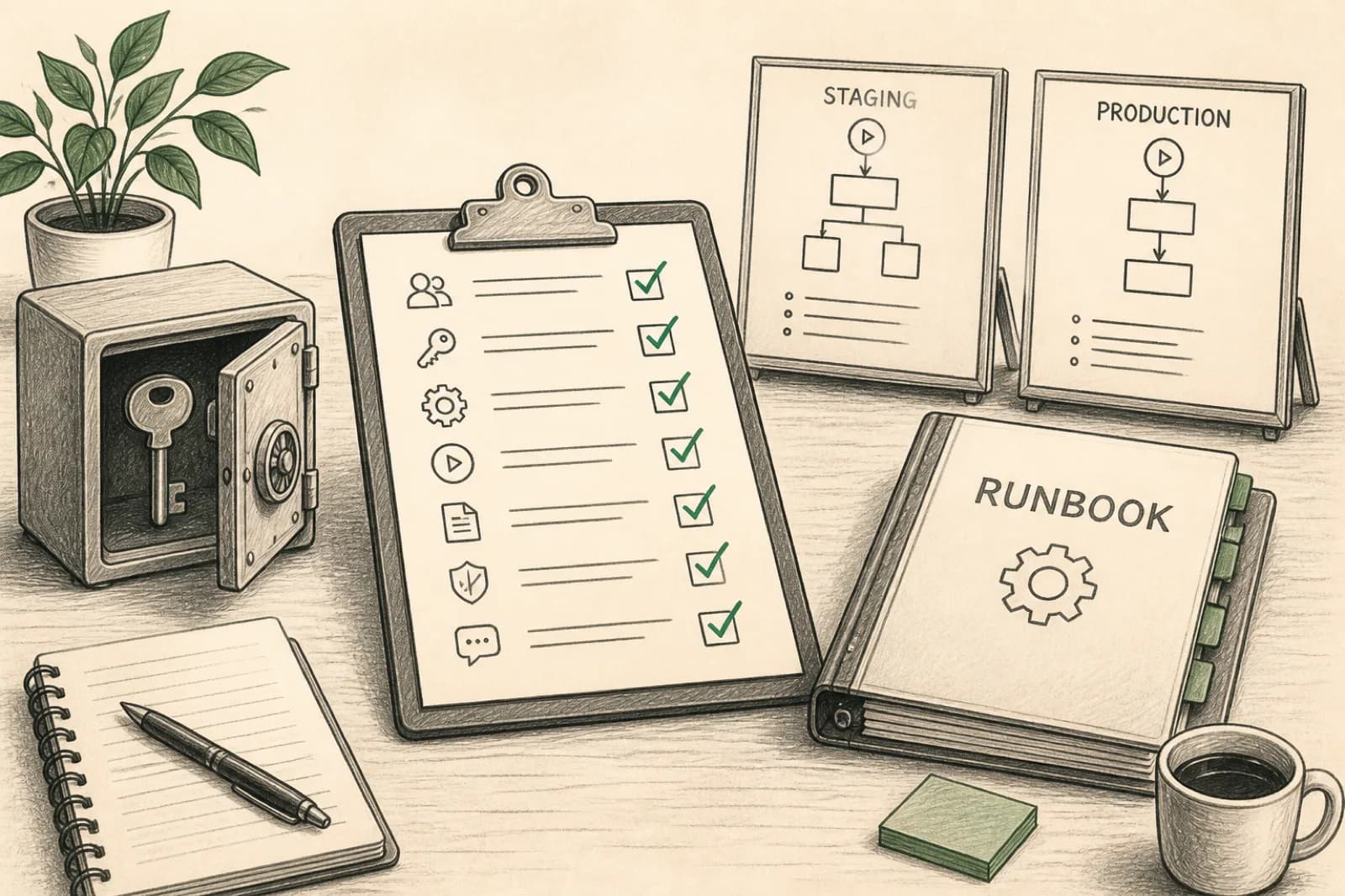
What “owned” actually includes
Owners
Primary + backup on alerts
Environments
Staging ≠ production secrets
Runbook
Trigger · fail · rollback
Keys
Inventory + rotation rule
Changelog
What changed last week
Graduate
When this becomes code
Insight: a canvas without this package is a demo. Delivery means someone else can operate it on Monday.
What "owned" means
Ownership is not "has login access." Ownership means:
- Primary and backup humans who accept alerts
- Authority to change production workflows under a change rule
- Responsibility for credential rotation and vendor access reviews
- A documented rollback that has been practiced once
If those seats are empty, keep the workflow in staging.
Ownership scorecard (use before you call it done)
| Check | Pass | Fail |
|---|---|---|
| Named primary + backup | Both people acknowledge alerts in writing | "The team" or "whoever is free" |
| Staging ≠ prod secrets | Separate credentials and webhooks | Shared personal OAuth in prod |
| Runbook one-pager | Trigger, fail, rollback in one place | Knowledge only in the builder's head |
| Change rule | Staging first; second pair of eyes on high-impact | Live-edit prod on Fridays |
| Export / backup cadence | Weekly recoverable export or Git sync | No history of last week's graph |
| Offboarding path | Rotate keys when someone leaves | Hope personal tokens keep working |
| Graduation criteria | Written trigger to move into product code | "We'll know when it hurts" |
A useful internal bar: time-to-recover for a broken critical workflow should be measurable in hours with the backup owner, not "whenever the original builder answers Slack."
Environments and secrets
Separate staging and production
Different credentials. Different webhook endpoints where possible. No "testing" against live customers with prod keys in a personal sandbox.
Put secrets in a vault, not in screenshots
Store tokens in your secret manager or n8n credential store with least privilege. Ban pasting keys into Slack, Notion, or the workflow notes field "just for now."
Rotate on a schedule and on offboarding
Builder departure is a security event. Rotate anything they could access. Automations that still work after a departure only because a personal OAuth connection survived are accidents waiting for expiry.
Change control that fits a small team
You do not need bureaucracy. You need a rule:
1. Edit in staging (or a duplicated workflow) first 2. Note what changed and why in a short changelog 3. Promote to production with a second pair of eyes for high-impact flows 4. Keep an export or Git-backed backup of production definitions on a cadence
For money-moving or customer-message flows, "second pair of eyes" is not optional.
The handoff checklist
Hand this package with the instance, whether to a client, an internal ops lead, or a future you:
| Artifact | Why it matters |
|---|---|
| Trigger description | How work enters the system |
| Happy-path diagram or steps | What success looks like |
| Failure path and dead letter | What humans do when it breaks |
| Idempotency keys | How retries stay safe |
| Credential inventory | What to rotate and who vendors bill |
| Alert destinations and on-call | Who wakes up |
| Staging vs prod map | How to test without harming customers |
| Changelog location | How to reconstruct last week's edit |
| Graduation criteria | When this should become product code |
If a delivery partner cannot produce this package, you bought a demo. The same standard applies to AI features in AI product ownership.
When to graduate into product engineering
Promote a workflow out of n8n when:
- It is discussed as part of the product roadmap
- Reliability or compliance needs exceed canvas discipline
- Multiple product teams must share ownership through normal code review
- Cost or latency requires deeper optimization than nodes afford
Graduation is success, not failure. n8n did its job as glue until the path deserved a service.
Closing the series
n8n is a strong workflow runtime when you treat it like production software: deliberate scope, honest runtime choice, failure design, narrow AI, and real ownership. Skip those and you have automated chaos with a nicer UI.
If you need a partner to scope handoffs, harden workflows, or plan a graduation into product code, start a conversation or read how we work. For quality around the edges of delivery, see QA and automation.