
Surface
The first demo of an AI feature is the easiest part of the project. A well-chosen prompt, a curated set of test inputs, and a live audience create a moment that feels like the product is done. Then the demo ends, real users arrive with inputs nobody rehearsed, the model provider ships an update, and the team discovers that "it worked in the demo" was never the same claim as "this is production-ready."
Stanford's 2025 AI Index has tracked this gap directly: capability benchmarks keep improving faster than organizational readiness to operate what gets built on top of them. McKinsey's research on agentic AI adoption found a similar pattern at the organizational level, with roughly 39% of companies experimenting with agents but only about 23% reporting they have scaled agents into production workflows. The gap between those two numbers is mostly an ownership gap, not a capability gap. Teams that close it treat the post-demo handoff as seriously as the build itself.
Why demos mislead teams about readiness
A demo is optimized for a narrow, known set of inputs, a controlled environment, and an audience that forgives minor rough edges because they can see the direction. None of that describes production. Real users send adversarial, ambiguous, and unexpected inputs. Model providers deprecate versions and change behavior without warning. Costs that looked negligible at demo volume compound quickly at real usage. None of these are the model's fault. They are the predictable result of skipping the operational package a feature needs before it earns unsupervised traffic.
The five things that must be handed off
1. Runbooks for known failure modes
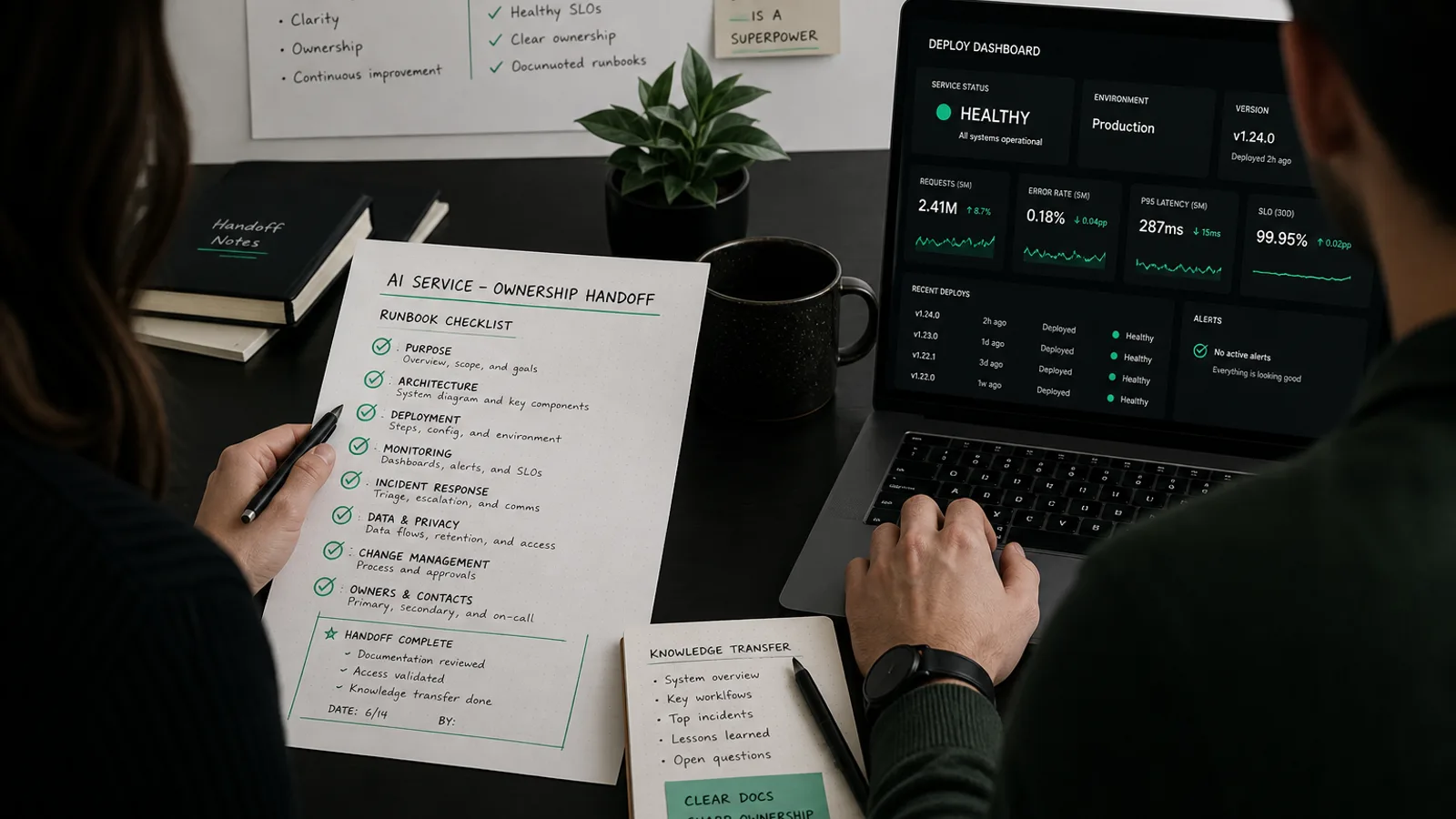
Every AI feature has a shortlist of failure modes discovered during build: hallucinated details in a specific input pattern, latency spikes under certain payload sizes, a tool call that occasionally returns malformed output. A runbook documents what the symptom looks like, how to confirm it, and what the immediate mitigation is, whether that is a fallback response, a rate limit, or a manual escalation path. Without this, every incident becomes a fresh investigation instead of a five-minute lookup.
2. An eval suite that outlives the demo
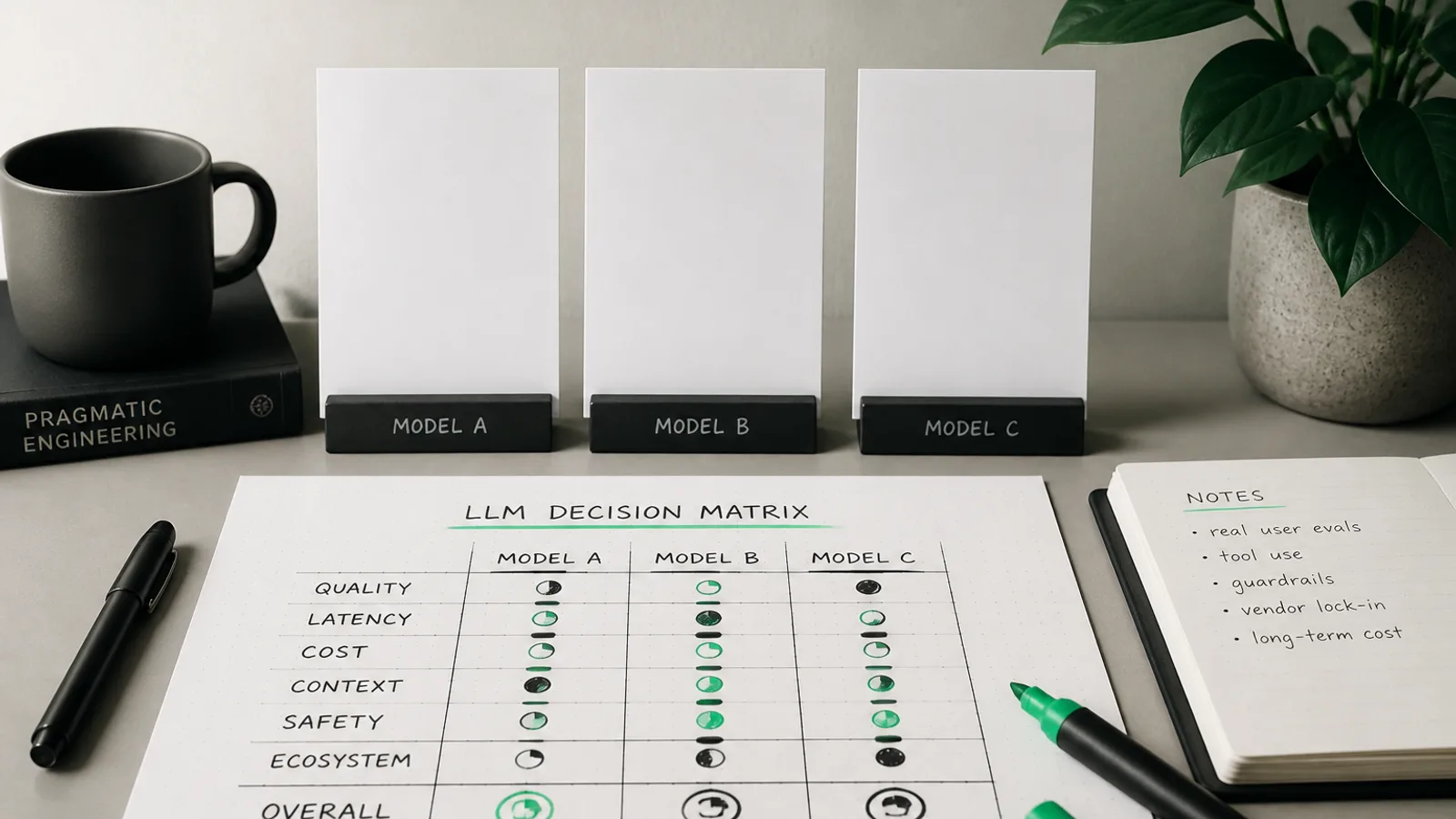
The test inputs used to validate a demo are rarely a real evaluation suite. A durable eval suite includes representative production-like inputs, known edge cases, and a scoring method the team agrees on before disagreements happen in a live incident. This suite should run automatically against every prompt change and every model version bump, the same way a test suite runs against every code change, a practice worth pairing with the model-comparison discipline in choosing an LLM for a 2026 product.
3. Clear ownership of prompts and versions
Prompts are production code and need the same discipline: version control, a documented rationale for each change, and a named owner who approves edits. Too many teams let prompts live as untracked strings scattered across a codebase, which makes it impossible to know why an output changed after a "small tweak" or to roll back cleanly when a change regresses behavior. Model version pinning deserves the same rigor. Decide explicitly whether the feature auto-updates to new model versions or requires a controlled rollout, and document that decision.
4. A cost dashboard someone actually watches
Token costs, tool-call costs, and infrastructure costs for an AI feature can grow nonlinearly with usage in ways that surprise teams who only budgeted from demo-scale traffic. A cost dashboard tracking spend per feature, per model, and ideally per customer segment should exist before the feature reaches broad traffic, with an alert threshold and a named owner who reviews it on a fixed cadence (weekly or monthly), before finance has to chase an unexpected invoice.
5. On-call coverage that understands the failure modes
AI features fail differently than typical application code: a provider outage, a subtle quality regression after a silent model update, a prompt injection attempt, or a cost spike from a traffic pattern nobody modeled. On-call rotation for an AI feature needs the runbooks from point one and enough context to distinguish "the model provider is degraded" from "our prompt regressed" from "a user is intentionally probing the system." Generic on-call training does not cover this without deliberate onboarding.
A comparison worth making explicit
Framing the handoff as a before-and-after helps teams see what changes:
- Demo-stage ownership: one engineer holds context informally, prompts live in scratch files, cost is estimated roughly, failures get debugged live, and no one is paged outside working hours.
- Production-stage ownership: prompts are versioned with a named approver, an eval suite gates every change, a cost dashboard has an alert threshold and an owner, documented runbooks cover known failure modes, and on-call rotation includes AI-specific context.
Neither stage is wrong for its moment. The mistake is staying in demo-stage ownership after the feature has real users and real cost exposure.
Sequencing the handoff
The handoff does not need to happen all at once, but it needs an explicit owner and a deadline tied to launch scope, instead of an indefinite "we'll formalize this later." A workable sequence: write the eval suite and runbooks before the feature reaches any traffic beyond an internal pilot, set up the cost dashboard and alert threshold before opening broader access, and establish on-call coverage and prompt version control before the feature is advertised externally. Each gate should have a named person who confirms it is done, with a dated sign-off rather than an unchecked planning checkbox.
This mirrors the broader delivery discipline behind shipping an AI MVP in 2026: a first release earns the right to more users by demonstrating it can be operated in production conditions, including after the demo audience leaves. The same applies to agentic features specifically, where the operational surface area is larger, a topic covered in agentic AI workflows versus chatbots.
Ownership boundaries that need a named person
Documented processes decay quietly when no individual is accountable for them. Beyond the five artifacts above, name a single owner for each of the following decisions, since ambiguity here is where handoffs quietly fail: who approves a prompt change before it ships, who decides whether to accept a model provider's new default version or pin the current one, who is paged first when the cost dashboard crosses its alert threshold, and who has authority to roll back a feature if an eval score regresses after a change. Writing "the team owns this" is equivalent to no one owning it once more than two people could plausibly respond.
Documenting what the feature does not do
An underrated part of the handoff is a written, current list of known limitations: input types the feature handles poorly, volume thresholds where latency degrades, and categories of questions it should decline rather than attempt. Support and on-call staff who know these boundaries can set user expectations and triage incidents faster than staff who only learn the limitations by encountering them live in production.
What to ask a delivery partner before they hand a feature back to you
If an external team built the AI feature, the handoff package above is exactly what to request before final acceptance: documented runbooks, a working eval suite with a repeatable scoring method, version-controlled prompts with a change log, a functioning cost dashboard, and a defined on-call plan with enough documentation for your team to actually run it. A partner that cannot produce these artifacts has built a demo, not a production feature, regardless of how polished the interface looks.
Our approach
We build the operational package alongside the feature, not after a client asks for it post-launch. That means eval suites are written while the feature is still being tuned, prompts are versioned from the first working draft, and cost instrumentation exists before broad rollout rather than being retrofitted after a surprising invoice. If you need a team that can both build an AI feature and hand it off in an operable state, our AI and ML practice can scope that with you, or if you need to add capacity to own this internally, Hire Talent can help you staff the ongoing ownership directly.