

Surface
In this essay8 sections
Context windows became a headline metric almost overnight. Kimi from Moonshot AI popularized very large windows for coding and document work, and most frontier labs now ship a long-context tier alongside their standard models. Buyers are left comparing numbers on a spec sheet without a clear sense of which number matters for their product.
The honest answer is that context length is a capability class, not a strategy. Stanford's 2025 AI Index tracked continued gains in effective context utilization alongside falling cost per token, which is exactly why long-context tiers became commercially viable this year. But a bigger window does not replace good retrieval, and retrieval does not replace a model that can reason across an entire codebase in one pass. The right call depends on the shape of your workload, not the size of the number in the marketing page.
Context windows as classes, not a leaderboard
It helps to think in bands rather than exact token counts, since providers revise limits often:
- 128k class - fits a mid-size repository module, a long contract, or a stack of research notes. The practical default for most retrieval-augmented products.
- 200k-300k class - comfortable for a full microservice, a quarter's worth of support tickets, or a multi-chapter document set without heavy chunking.
- 1M+ class - associated with Kimi-style and other frontier long-context APIs. Useful for whole small-to-mid codebases, large regulatory filings, or many documents in one pass, but priced and latency-bound accordingly.
None of these bands guarantee quality. Needle-in-a-haystack benchmarks improved dramatically through 2025, but multi-hop reasoning across a full window still degrades for many models well before the stated limit. Treat the advertised window as a ceiling on what fits, not a promise of what the model will use well.
Where long context genuinely wins
Whole-codebase and whole-repo reasoning
When a task requires understanding how a change in one module ripples through call sites, config, and tests, chunked retrieval fights the model instead of helping it. Pasting a full module tree, or as much of it as a long-context model can hold, lets the model trace dependencies the way a senior engineer would scan a file tree before touching a line. This is the strongest current case for 200k-1M+ token windows, and it is a direct complement to the model-selection tradeoffs covered in choosing an LLM for a 2026 product.
Long contracts, filings, and compliance documents
Contracts, prospectuses, and regulatory filings are internally cross-referenced. A clause on page 40 modifies a definition on page 3. Splitting that document into retrieval chunks breaks exactly the links a reviewer needs. A long-context pass that ingests the full document, or a clearly bounded section of it, produces more reliable clause-linking and obligation extraction than chunk-and-retrieve pipelines.
Multi-document research synthesis
Comparing five vendor proposals, three years of board minutes, or a stack of customer interview transcripts benefits from a model that can hold everything in working memory at once. The output quality gain over retrieval is most visible in tasks that require noticing what is missing or contradictory across documents, since retrieval systems only surface what a query explicitly asks for.
Where RAG still wins, and usually by a wide margin
Cost at scale
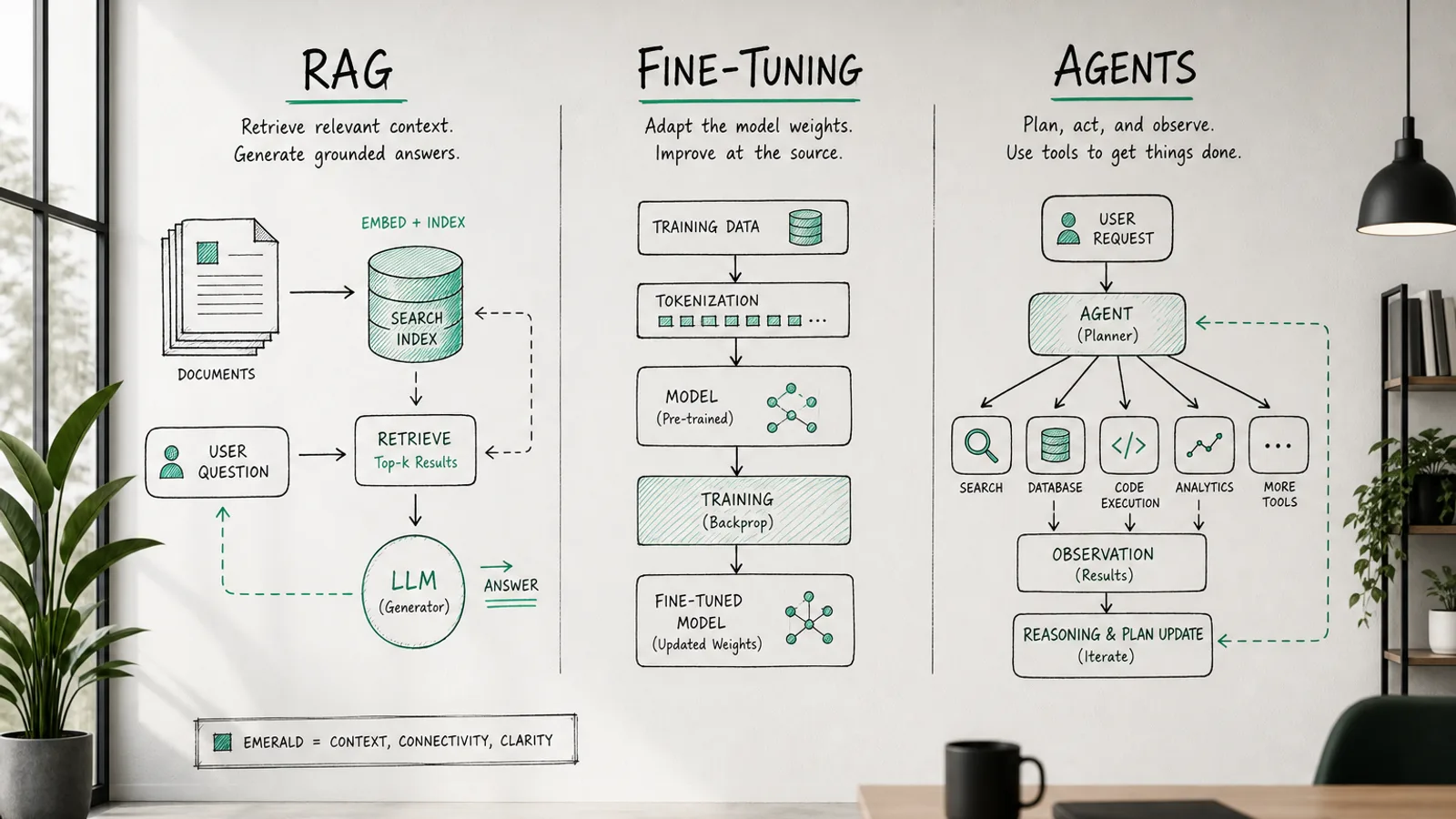
Long-context calls charge for every token in the window on every request, even when 95% of that window is irrelevant to the question asked. Retrieval narrows the prompt to the handful of passages that matter, which keeps per-query cost predictable as traffic grows. For any product answering thousands of queries a day against a large, mostly-static corpus, retrieval is still the economically sane default, a point covered in depth in RAG vs. fine-tuning vs. agents.
Cacheability
Retrieval pipelines cache embeddings, cache retrieved chunks, and cache final answers for repeated queries. Long-context prompts are harder to cache because the assembled context often differs slightly between requests, which limits the benefit of provider-side prompt caching even when it is available.
Freshness
A long-context model only knows what you stuffed into the window at request time. If your underlying data changes hourly, support tickets, inventory, prices, you need a retrieval layer that can requery fresh data anyway. At that point, adding a long-context pass on top of retrieval usually duplicates cost without improving freshness.
A simple way to hold both tradeoffs side by side:
- Long context wins on: whole-artifact reasoning, cross-reference-heavy documents, one-off or low-volume analysis, tasks where missing context causes silent errors.
- RAG wins on: cost per query at scale, cacheable and repeatable traffic, frequently changing data, corpora far larger than any context window could hold.
- Long context loses on: cost per query, cache hit rates, and handling corpora larger than the window regardless of size.
- RAG loses on: cross-document synthesis, subtle omissions, and tasks where the answer depends on the whole document rather than the top-k passages.
The hybrid pattern most teams actually ship
Very few production systems pick one approach exclusively. The pattern we see succeed most often is retrieval-first with a long-context escalation path: a fast retrieval pass handles the majority of queries cheaply, and a smaller set of complex, cross-referencing, or high-stakes queries escalate to a long-context call that ingests a larger, pre-filtered slice of the corpus. This keeps average cost low while reserving the expensive capability for the queries that actually need it.
Agentic retrieval is a variant worth naming separately: instead of a single retrieval pass, an agent iteratively decides what to fetch next based on what it has already read, then assembles a long-context prompt from the results. This tends to outperform both naive RAG and blind long-context stuffing on genuinely multi-hop questions, at the cost of more orchestration and latency, a tradeoff explored further in our note on agentic workflows versus chatbots.
Cost and latency math you should not skip
Before committing to a long-context architecture, run the numbers on three dimensions: cost per query at expected volume, time-to-first-token at your target window size, and the failure cost of a stale or incomplete answer. Long-context calls at the 1M+ class can take meaningfully longer to first token than a retrieval-narrowed prompt, which matters for interactive products but matters far less for asynchronous batch analysis.
Also model your corpus growth. A workload that fits comfortably in a 128k window today may not fit in twelve months. Decide up front whether you will re-architect toward retrieval at that point or keep scaling the context tier, because retrofitting retrieval into a long-context-only product later is more disruptive than designing for it from the start.
Evaluating a long-context model before you commit
Do not trust a provider's stated window as a proxy for usable quality. Build a small evaluation set from your own documents: place a known fact near the start, middle, and end of a realistic-size context, then ask a question that requires combining it with a fact elsewhere in the same window. Many models score well when the relevant fact sits near the end of the prompt and measurably worse when it sits in the middle, a pattern sometimes called "lost in the middle." Run this test at the context size you actually intend to use, not the maximum advertised size, since degradation is rarely linear.
It is also worth testing with adversarial length: pad the context with plausible-looking but irrelevant material and see whether the model's answer quality holds. Production inputs are rarely as clean as a benchmark document, and a model that performs well on curated long-context benchmarks can still struggle when the surrounding text is noisy, repetitive, or contains near-duplicate passages, which is common in scraped documentation or ticket histories.
A rollout checklist
- Corpus size and growth rate are estimated for the next 12 months, including expected document additions
- Query volume and expected repeat-query rate are known, since they drive cacheability gains
- A clear list exists of which query types need cross-document reasoning versus lookup
- Cost per query is modeled at both current and 10x volume for each candidate architecture
- A hybrid escalation path is designed rather than an all-or-nothing commitment
- Freshness requirements are mapped against how each architecture handles updated data
Our approach
We evaluate long-context and retrieval architectures against the actual query mix a product will see, not against benchmark leaderboards. That usually means prototyping both paths against a sample of real queries before committing budget to one architecture, then designing the hybrid escalation boundary so cost stays predictable as usage grows. If you are scoping an AI feature and are not yet sure which pattern fits, our AI and ML team can help pressure-test the workload before you build, alongside the broader model-selection questions covered in shipping an AI MVP in 2026.