
Surface
Teams scoping an AI feature frequently jump straight to the most sophisticated architecture available: an agent that can plan, call tools, and iterate. That instinct is usually backwards for a first release. Retrieval-augmented generation (RAG), fine-tuning, and agents solve different problems, and the right choice for a v1 is almost always the simplest one that satisfies your actual constraint, not the most capable one on paper.
Adoption data backs up how quickly this space is moving, and how much room there still is between experimentation and disciplined production use. McKinsey's late-2025 research found that roughly 88% of organizations now use AI in at least one business function, but only about 23% report scaling agentic AI approaches in a meaningful way, and only around 39% see any measurable EBIT impact from their AI initiatives at all. The gap between broad adoption and real bottom-line impact is largely an architecture-and-scoping gap: teams reach for capability before they've proven the underlying task works.
The three shapes, in plain terms
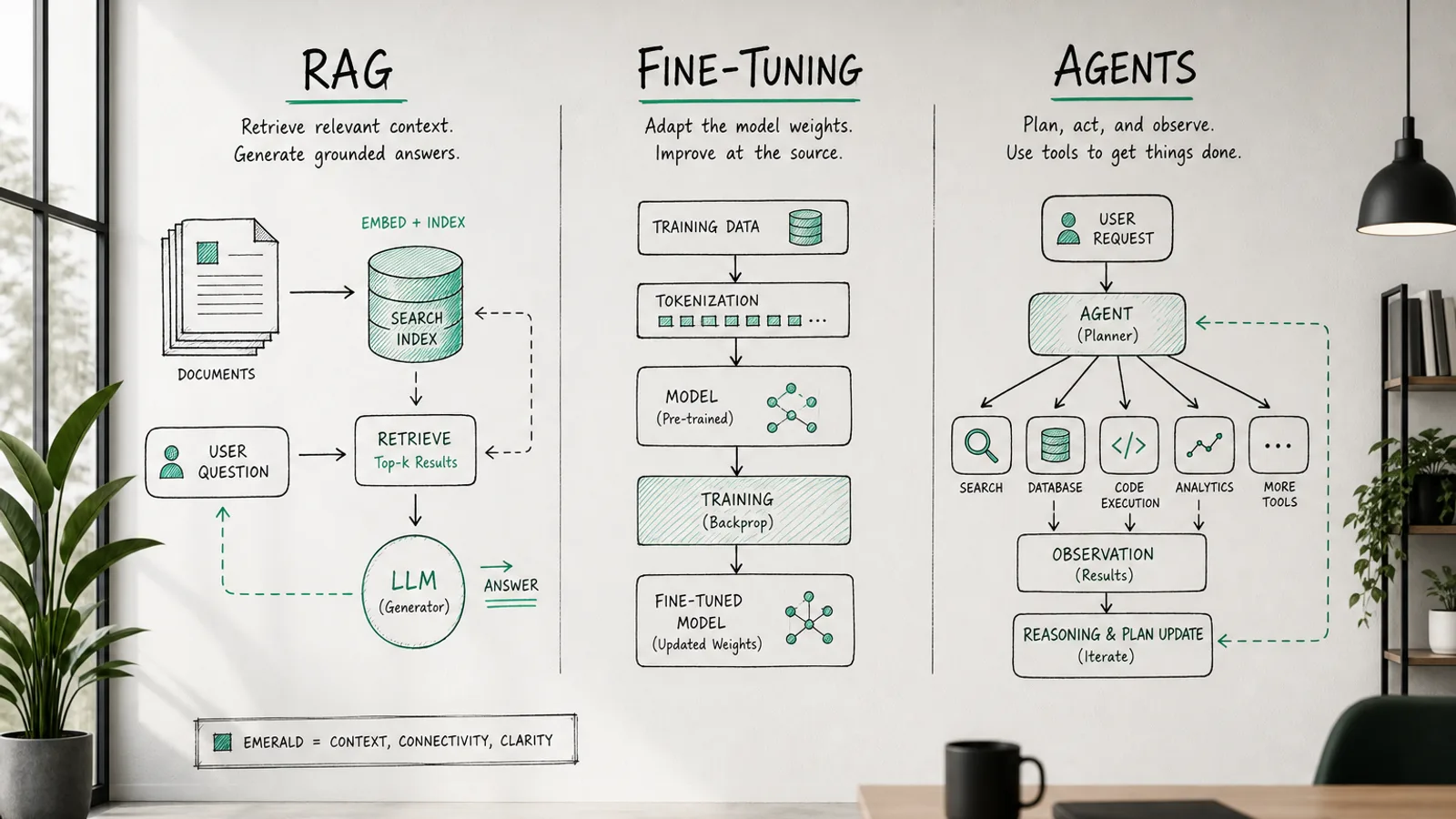
Retrieval-augmented generation (RAG) connects a general-purpose model to your own data at query time. Instead of relying on what the model memorized during training, the system retrieves relevant documents or records and includes them in the prompt, so the model answers grounded in your actual content.
Fine-tuning adjusts a model's weights on examples of your data, typically to change its style, format, tone, or domain vocabulary, not to give it access to facts it doesn't have. A fine-tuned model still cannot answer questions about data it never saw during training or retrieval.
Agents give a model the ability to take multi-step actions: call APIs, run code, query databases, and decide what to do next based on intermediate results, rather than producing a single response to a single prompt.
A comparison for first-release decisions
| Dimension | RAG | Fine-tuning | Agents |
|---|---|---|---|
| Best for | Grounded answers over your own content | Consistent style, format, or domain language | Multi-step tasks needing tool use |
| Data requirement | A searchable corpus, no labeled training pairs needed | A stable, representative labeled dataset | A defined, bounded toolset |
| Update cadence | Update content anytime; no retraining needed | Requires retraining when style/data needs change | Update tools and permissions independently of the model |
| Failure mode if misapplied | Irrelevant retrieval, weak grounding | Stale outputs after retraining lag, no new facts learned | Runaway actions, unpredictable cost, unclear accountability |
| Relative build complexity for v1 | Low to moderate | Moderate to high (data curation, training, evaluation) | High (permissions, guardrails, monitoring) |
| Typical first-release fit | Default starting point for most grounded-answer products | Add once RAG output style/format is proven insufficient | Add once a single-step response can't complete the actual job |
The default decision path
For most first releases, this ordering avoids the common mistake of reaching for agentic complexity before proving the simpler shape is insufficient:
Start with RAG for grounded answers
If the task is "answer a question using our documentation, our product catalog, our internal knowledge base, or our historical records," start with retrieval. It requires no training data curation beyond having a reasonably organized corpus, it updates instantly when your underlying content changes, and it directly addresses the most common AI product failure: confidently wrong answers about your own business. This is almost always the right default starting point, and many products never need to move past it.
Move to fine-tuning when the data is stable and the gap is style, not facts
Fine-tuning earns its complexity when RAG's retrieved-and-prompted output is factually fine but stylistically wrong for your use case: it doesn't match your brand voice, it doesn't follow a required output format precisely enough, or it doesn't use your domain's specific terminology naturally. Fine-tuning is a poor fit for "the model doesn't know facts about us," which is a retrieval problem, not a style problem. It's also a poor fit when your underlying data changes frequently, since every meaningful change requires a retraining cycle. Fine-tuning is worth the investment when your data and desired style are both stable enough to justify the training and evaluation overhead.
Reach for agents only when the task genuinely requires multiple steps
Agents solve a different problem entirely: tasks that cannot be completed by a single well-grounded response, because they require looking something up, then taking an action based on what was found, then verifying the result, potentially across multiple systems. If your task can be fully answered by a single retrieval-augmented response, an agent adds cost, latency, unpredictability, and operational risk without adding value. Reach for an agent when the job genuinely has sequential steps with branching logic, not because agentic architectures are the current focus of the industry.
Why McKinsey's scaling gap matters here
The fact that only about 23% of organizations report scaling agentic approaches, against roughly 88% using AI somewhere, is not evidence that agents don't work. It's evidence that most teams correctly recognize agents are the highest-complexity, highest-risk shape and are proceeding carefully, often after simpler shapes prove insufficient. The roughly 6% of organizations McKinsey characterizes as high performers on AI tend to be disciplined about matching architecture to task, not about deploying the most advanced pattern everywhere. That discipline is directly transferable to a first release decision: match the shape to the actual job, and let evidence, not architecture trend, justify the added complexity of agentic tool use.
Combining shapes without starting there
Production systems frequently end up combining these approaches, but the sequencing matters. A support product might start as pure RAG, add fine-tuning once the team confirms the answer style needs adjustment beyond what prompting can fix, and only later add a bounded agent capability for a specific sub-task like "look up an order and issue a refund within a defined limit." Building all three from day one, before evidence justifies each layer, multiplies the surface area you need to test, monitor, and secure without a corresponding increase in validated value.
If you're building an agentic capability, the operational requirements, permissions, audit logging, and human checkpoints, deserve their own scoping pass; we cover that in agentic AI in products: workflow, not chatbot theater. And if you're still validating whether the underlying task is feasible at all before committing to any of these three shapes, start with the evaluation-first approach in AI MVP in 2026.
A quick decision checklist
Before committing engineering time to an architecture shape, confirm:
- The task has been tested with a plain prompted call first, to establish a baseline
- If facts about your own data are missing, retrieval has been tried before considering fine-tuning
- If style or format is the actual gap, fine-tuning is justified by a stable enough dataset to make retraining worthwhile
- If the task requires multiple sequential steps, an agent's tool list and permission boundaries are explicitly scoped, not open-ended
- The chosen shape is the simplest one that satisfies the evidence, not the most sophisticated one available
Getting this sequencing right on a first release saves teams from building agentic infrastructure for a task that a well-grounded single response could have handled, and it keeps the option to add complexity open for when the evidence actually calls for it.
Need a second opinion on which shape fits your task? Explore our AI & ML solutions or start a conversation about your specific product.